eBay Selling Fees UK 2026: The Complete Guide for Sellers
What eBay actually takes from a UK sale in 2026, for private sellers, business sellers, Motors listings, and everything in between. Checked against eBay's UK fee pages on 6 August 2026.
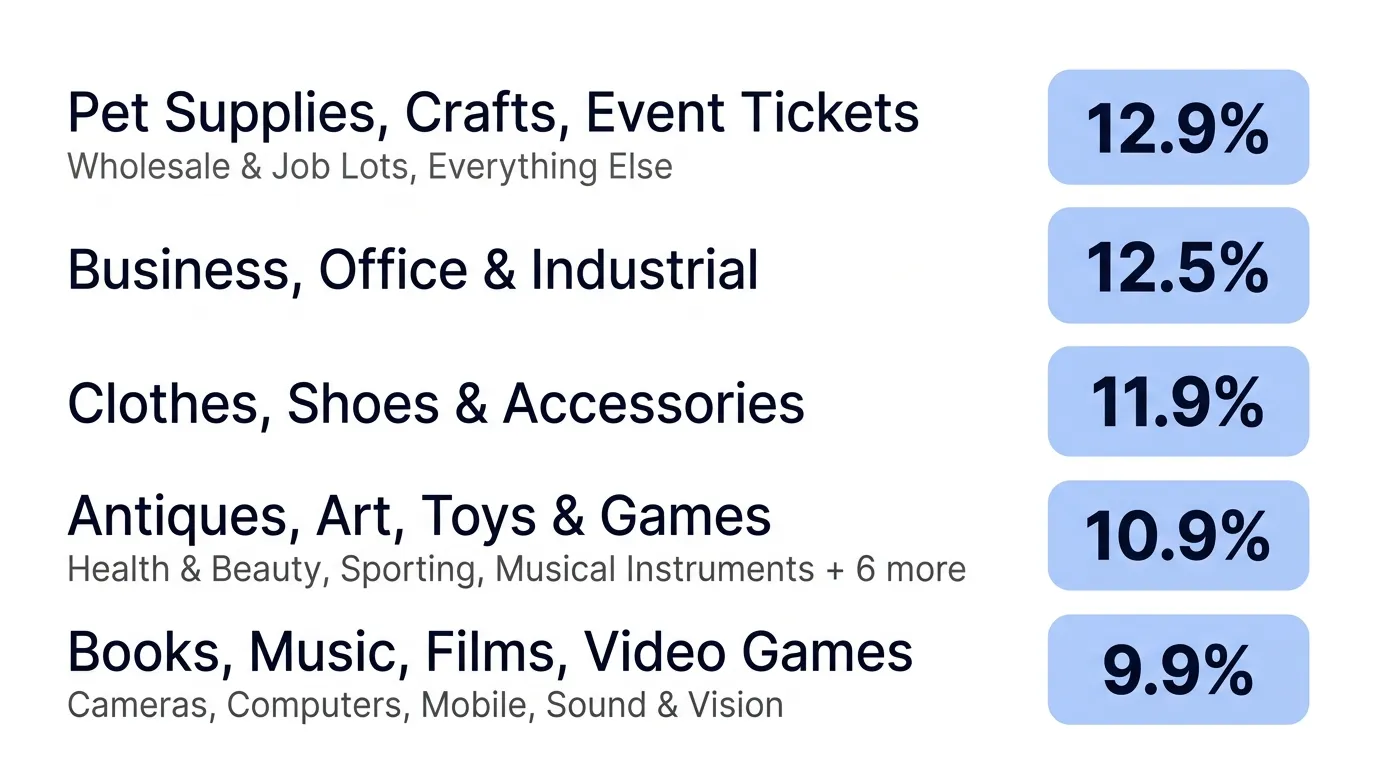
eBay UK has two seller account types in 2026, private and business, plus a separate Motors fee schedule. Eligible domestic sales by private sellers have no transaction fees; eBay charges the buyer a Buyer Protection Fee instead, although listing upgrades, international, dispute, overage and Motors fees can still apply. Business sellers typically pay 10-13% before VAT per sale. That's a category-based Final Value Fee (6.9%-14.9%; most items 9.9%-12.9%), a per-order fee (£0.30 or £0.40), a Regulatory Operating Fee (0.35%), plus 20% VAT. VAT on business fees may be reclaimable under normal VAT accounting, subject to HMRC's input-tax rules; Flat Rate Scheme users generally cannot reclaim it separately. Motors uses separate insertion and sale fees, including percentage-based capped fees for auction and fixed-price listings.
Private seller vs business seller vs Motors, which one are you?
eBay UK has two seller account types, private and business. Motors is a separate fee regime that can apply to either account type.
| Seller type | Who qualifies |
|---|---|
| Private | Selling personal items you no longer want, clearing the loft, old clothes, an unwanted bike. Not buying stock to resell. |
| Business | You sell items bought to resell, make items to sell, or buy items for your business. See eBay's Business seller policy. |
| eBay Motors | Cars, motorcycles, vans, scooters, motorhomes. Vehicle parts and accessories sit in regular categories, not Motors. |
eBay's account classification and HMRC's tax-reporting rules are separate tests. Under eBay's policy, business sellers cannot represent themselves as private sellers. HMRC's £1,000 trading allowance determines when gross trading income generally needs to be reported; it is not an eBay business-account threshold.
Private sellers
Private seller eBay fees, free on UK sales
Since 1 October 2024, eligible domestic listings by private sellers have no Final Value Fee, per-order fee or regulatory fee. The buyer pays the Buyer Protection Fee on top. Other charges can still apply in the cases listed below.
Free selling applies when:
- You're registered as a private seller
- Your buyer is in the UK
- You're not in the Motors category
- You've listed fewer than 300 items this month
You still pay if:
- Over 300 listings/month: 35p each above the cap (inc. VAT)
- International buyer: a flat 3% of the total sale (not the tiered business rates)
- Paid upgrades (charged at listing):
- Subtitle - £2
- Gallery Plus - £2.50 (free in Clothes, Home & DIY, Pet Supplies)
- International Site Visibility - 30p fixed-price
- Special Duration - 35p
- Second category - 35p
- Promoted Listings - variable
- Dispute fee: £16.80 per chargeback (inc. VAT)
- eBay Shop: £19.99/mo, 400 free listings, the extra 100 include the 1-/3-day Special Duration upgrade
- Motors: separate fee model (see below)
Business sellers
Business seller eBay fees, the four-fee stack
Four separate fees hit every sale. Most sellers watch the Final Value Fee and miss the other three.
The four-fee stack:
- Final Value Fee: 6.9%-14.9% by category (most items 9.9%-12.9%), on item + postage
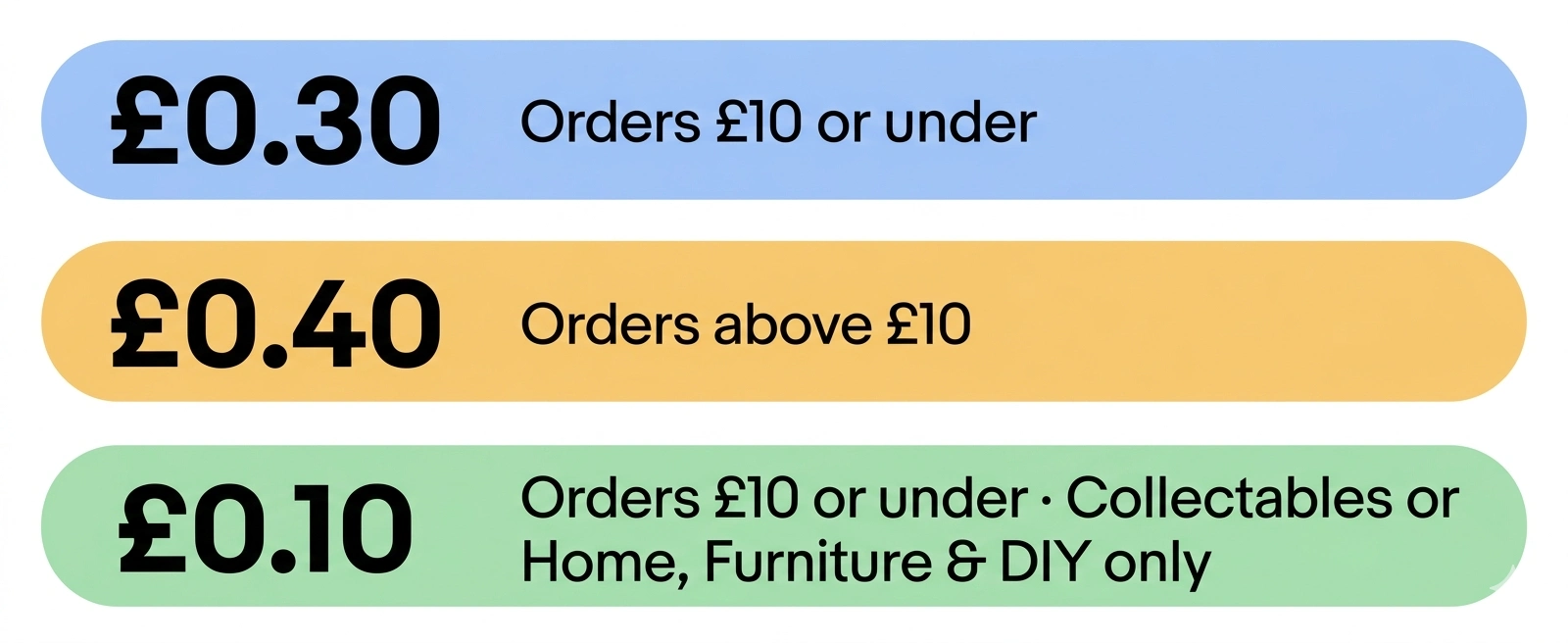
- Per-order fee: £0.30 if the order is ≤£10, £0.40 above
- Regulatory Operating Fee: 0.35% of the total transaction
- VAT: 20% on top of all fees (input VAT may be reclaimable under normal VAT accounting, subject to HMRC's rules)
Typical effective rate:
- 10-13% of the total transaction on most sales
- Higher (15%+) on small sales, where the fixed £0.40 takes a bigger bite
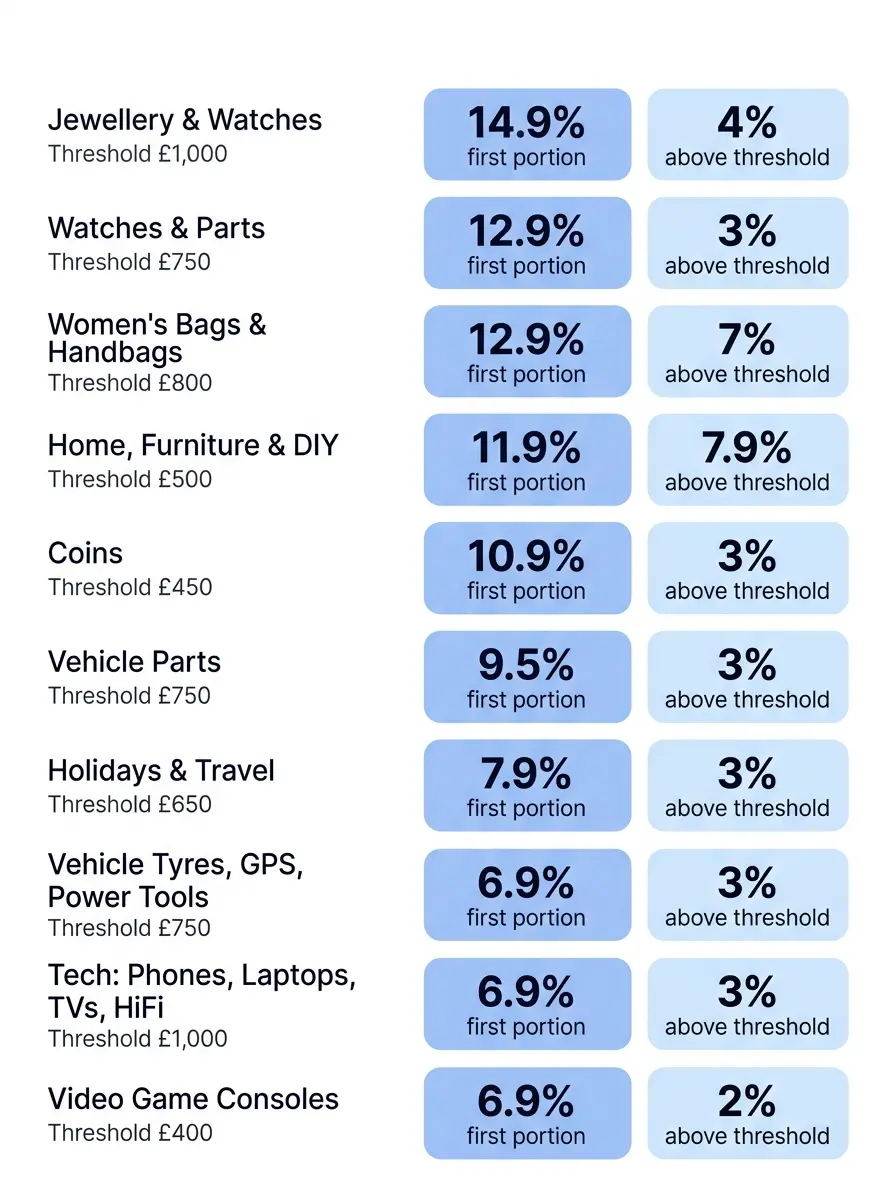
- Lower in banded high-value categories (Jewellery, Watches, Vehicle Parts), where the FVF drops sharply above the threshold
- Plus Promoted Listings if you opt in
The Buyer Protection Fee, what your buyer pays (not you)
On eligible private-seller listings, eBay includes the Buyer Protection Fee (BPF) in the item price buyers see while browsing, bidding or making an offer, then breaks it out at checkout. It is charged to the buyer rather than deducted from your listed price, although any separate seller charges such as paid upgrades, international, dispute, overage or Motors fees can still reduce your payout.
The BPF is tiered. The rate gets smaller as you move up each band:
| Component | Buyer charge |
|---|---|
| Fixed component | £0.10 per item |
| First £20 of the item price | 7% (up to £1.40) |
| Portion from £20.01 to £300 | 4% (up to £11.20) |
| Portion over £300, up to £4,000 | 2% |
The Final Value Fee (FVF), eBay's commission, by category
You pay eBay's commission only when your item sells. It's a percentage of the total sale, the item price plus any postage the buyer pays. The rate depends on your item's category.
Most items sit in five core bands: 9.9%, 10.9%, 11.9%, 12.5% or 12.9%. High-value categories use banded fees: a higher rate on the first slice of the sale, then a lower rate above a threshold.
The Trainers £100 rule
Trainers (Men's and Women's Shoes > Trainers) have their own rule. The default FVF is the Clothes & Shoes base rate of 11.9%. But if the item price (postage excluded) is £100 or more, the whole sale flips to 7%. No band, a clean threshold flip.
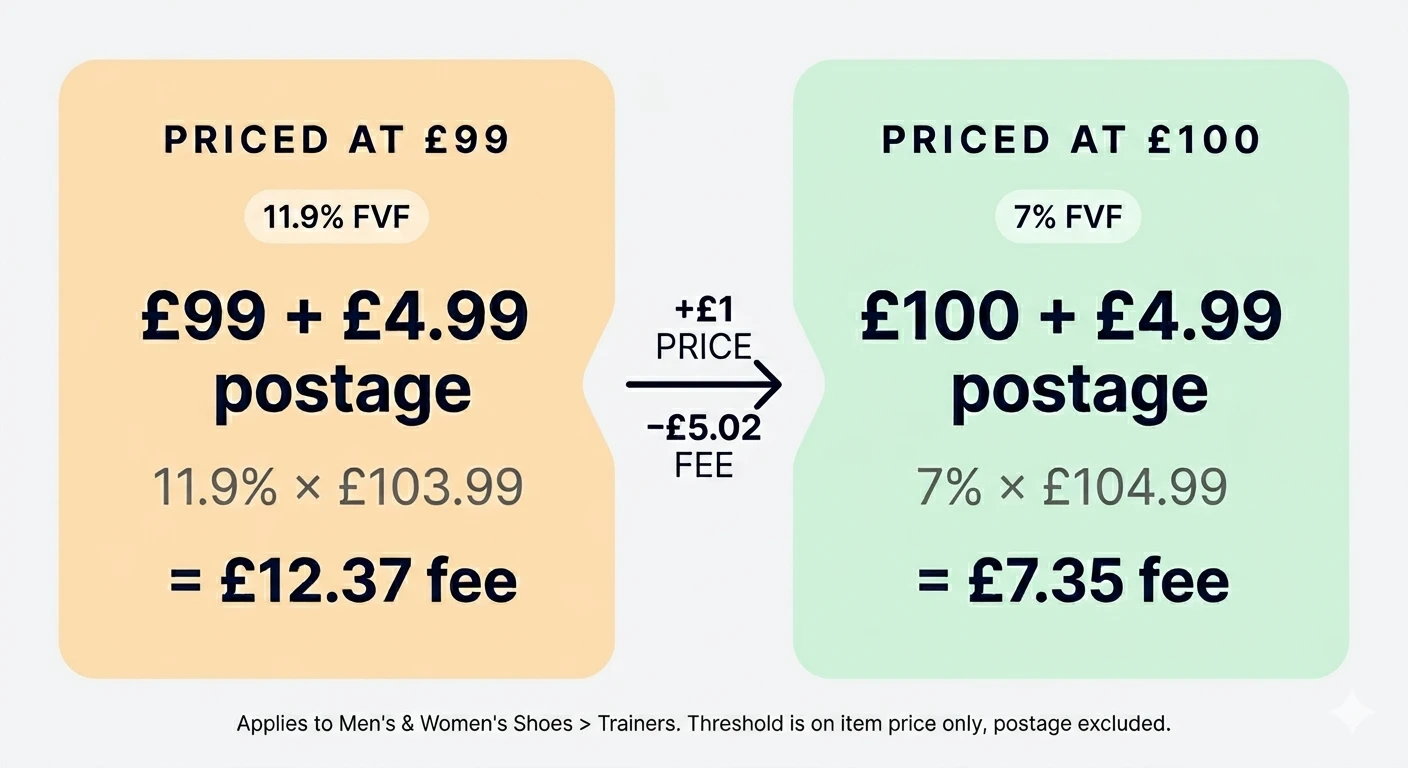
A £1 price increase saves £5.02 in FVF. Listing trainers near £100? Reprice up.
Banded fees on high-value items
Several categories charge a high rate on the first slice of the sale, then drop sharply above a threshold. So on big-ticket items the real rate lands well below the headline. The calculator handles every band.
The per-order fee and Regulatory Operating Fee, the two extras most sellers miss
Two flat fees sit on top of the percentage FVF. They make a real difference on smaller sales.
Regulatory Operating Fee: a flat 0.35% on every business-seller sale (item + postage).
Insertion fees, when you pay just to list
Private sellers receive 300 free listings a month in most categories. Business sellers without a Shop do not receive a free listing allowance; business Shop subscriptions include tier-specific allowances. You pay an insertion fee when:
- Private sellers go over 300 listings/month: £0.35 per extra listing.
- Business sellers have no Shop subscription: there is no free allowance; each fixed-price or auction-style listing is £0.30 in most categories.
- eBay Motors listings: always pay a non-refundable insertion fee, see the Motors section.
- Reserve auction listings: the optional Reserve Price fee is 4% of the reserve, capped at £150, and is non-refundable whether or not the item sells.
- Listing upgrades: Subtitle (£2), Gallery Plus (£2.50, free in Clothes/Shoes/Accessories, Home/Furniture/DIY and Pet Supplies), International Site Visibility (business: 25p fixed-price / 4p-13p auction by start price ex VAT; private: 30p fixed-price / 5p-15p auction inc VAT), Special Duration 1-/3-day (35p), Scheduler and Buy It Now upgrade (both free). Paid upgrades are non-refundable. For business sellers, applicable listing and optional upgrade fees are charged again each month on Good 'Til Cancelled listings and on every relist. Private sellers are not charged again for automatic renewals or automatic relisting, but manual relists can incur the fees again.
Listing 400+ items a month as a private seller? An eBay Shop subscription unlocks a bigger allowance. It's often cheaper than paying £0.35 on hundreds of extra listings. Use the Shop Tier Calculator to find your break-even.
Auction fees, same FVF, plus reserve price fee if you set one
Auctions don't cost more than Buy It Now. The Final Value Fee, per-order fee, and regulatory fee are the same. The only extra is the optional Reserve Price Fee.
A reserve is the lowest price you'll accept. The minimum on eBay UK is £50, and below it you don't have to sell. The Reserve Price Fee is 4% of your reserve, capped at £150 per item. You pay it even if the item doesn't sell, the FVF only applies when it does.
For business sellers, every auction relist is another use of the Shop allowance or another insertion fee, while Good 'Til Cancelled fixed-price listings incur applicable listing and optional upgrade fees each month. Private sellers are not charged for automatic renewals or automatic relisting, but manual relists can incur fees.
eBay Motors UK fees, selling cars, motorcycles, and vans
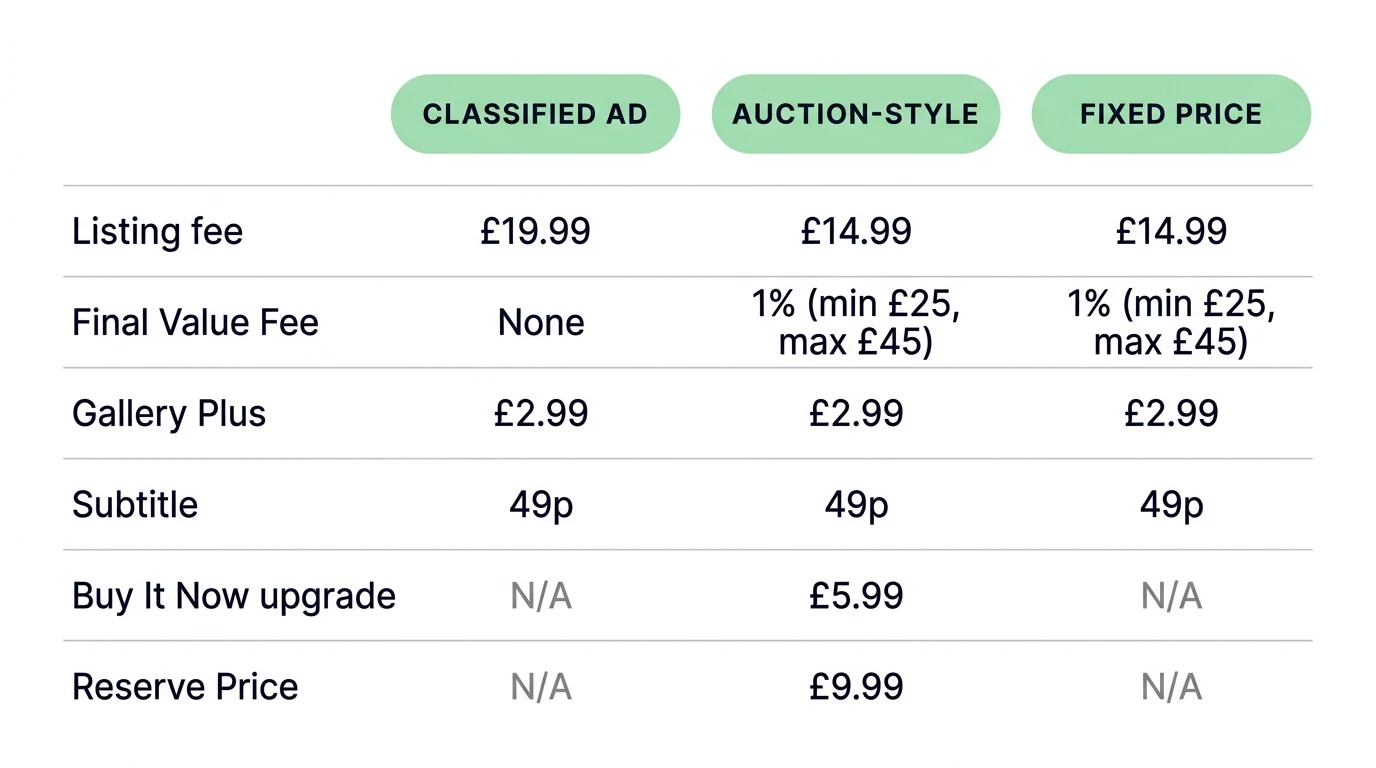
eBay Motors UK uses a separate listing-fee and sale-fee schedule set by listing type. A private-seller car is £19.99 to list as a Classified Ad (no sale fee), or £14.99 plus a 1% capped fee (£25-£45) on auction or fixed price.
Motors has three listing formats:
- Classified Ad, highest listing fee, but no FVF when it sells. You finish the deal off eBay. Cheapest overall for vehicles that will sell.
- Auction-style, lower listing fee, plus a capped FVF of 0.9-1% when it sells. Buy It Now and Reserve Price are optional add-ons.
- Fixed price, same listing fee and FVF rate as auction, but no bidding.
Motors fees for private sellers (inc. VAT)
Motors fees for business sellers (ex. VAT)
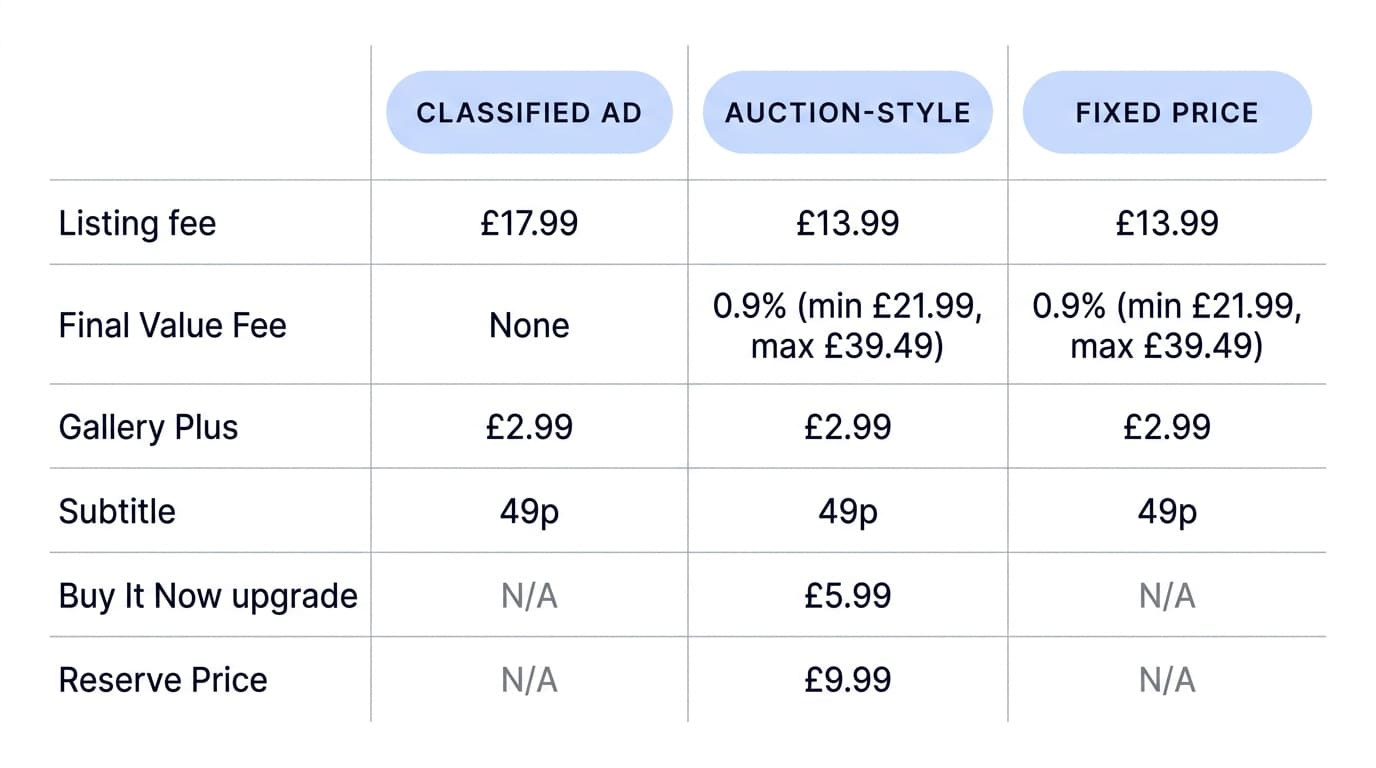
Listing Designer and Scheduler are free in every format. VAT-registered motor dealers can apply for an eBay Motors Pro account, which has its own fees for high-volume dealers. Source: eBay UK Motors fees ↗.
Worked example, selling a £6,000 used car as a private seller:
- Classified Ad: £19.99 listing fee, no FVF. Total: £19.99. Cheapest if you're sure the car will sell, you handle the buyer off eBay.
- Auction-style: £14.99 listing + £45 FVF (1%, capped) = £59.99 total. Reserve adds £9.99.
- Fixed price: £14.99 listing + £45 FVF = £59.99 total.
Motors fees apply to both private and business sellers. The October 2024 free-selling change for UK private sellers does not cover Motors. VAT-registered motor dealers can apply for an eBay Motors Pro account, which has its own fee schedule.
eBay Shop subscription fees, when paying for a shop pays off
The business Shop has three monthly tiers: Basic at £27, Featured at £77 and Anchor at £437 (all ex-VAT). Each step up buys a bigger listing allowance, lower insertion fees over it, and more branding tools, a shopfront, Daily Deals eligibility, packaging vouchers and the European Sales Booster.
Private sellers, £19.99/mo single tier
There's one option: £19.99/month (inc. VAT) for 100 extra free listings (400 a month, up from 300). Those extra 100 also include the 1- or 3-day Special Duration upgrade (normally 35p each). Go past 400 and the usual 35p overage kicks in. There's no FVF cut (private sellers don't pay FVF), no shopfront and no Daily Deals, it's just a listing-allowance boost. Worth it if you keep hitting the 300 cap, or want to try 1-/3-day durations without paying 35p each.
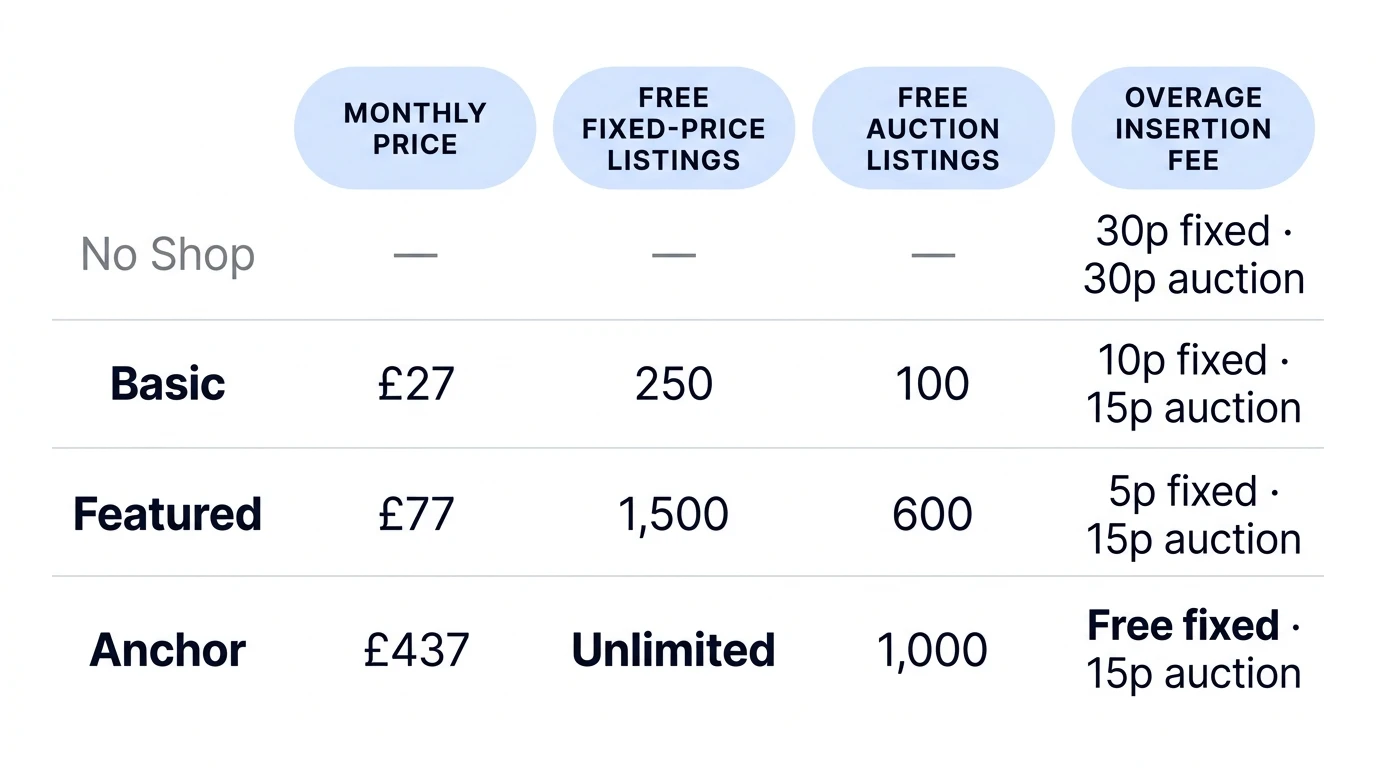
Source: eBay UK Shop subscription fees ↗. All prices ex-VAT; 20% VAT is added on top. Eligible VAT-registered businesses using normal VAT accounting may reclaim the business-use input VAT with valid evidence.
Promoted Listings general campaigns, pay after an attributed sale
With a Promoted Listings general campaign, you choose an ad rate from 2% to 100%. eBay charges the ad fee after an attributed sale, when the promoted item sells within 30 days of a click on one of its general ads. The fee is based on the total sale amount, including the item price, postage, taxes and any other applicable fees.
Priority campaigns work differently: they use cost-per-click (CPC) pricing, so you can be charged for a click whether or not it leads to a sale. See eBay's Promoted Listings overview for the current attribution and charging rules.
Whichever campaign type you use, advertising costs sit on top of eBay's selling fees. Enter your planned general-campaign rate in the fee calculator to see how it changes your margin.
Promoted ad fees compound on top of FVF
A 5% general-campaign ad rate creates a £5 ad fee before VAT when the total sale amount is £100. That is charged in addition to the Final Value Fee and other selling fees, so compare campaign performance and margin by category before changing your rate.
VAT on eBay fees, reclaim rules depend on your VAT scheme
eBay UK adds 20% VAT to every business-seller fee. That covers the Final Value Fee, per-order fee, regulatory operating fee, Promoted Listings, Shop subscription and listing upgrades. Your invoice shows fees both ex-VAT and inc-VAT.
Under normal VAT accounting, a VAT-registered business can normally reclaim VAT correctly charged on eBay fees to the extent those fees support taxable business activity. You need valid VAT evidence, and any private, non-business or exempt-use element can restrict the claim.
Under the Flat Rate Scheme, you generally cannot reclaim VAT on eBay fees separately. The scheme's limited exception is for certain capital assets costing more than £2,000, not marketplace service fees. Whether normal VAT accounting or the Flat Rate Scheme costs less depends on your turnover, business type and recoverable inputs; there is no universal winner.
Nearing the £90k VAT registration threshold? Use the VAT Strategy Calculator for an initial comparison, then confirm eligibility and treatment with HMRC or a tax adviser.
How much does eBay take from a £X UK sale?
Short answer: on a typical business-seller sale you pay a 9.9%-12.9% Final Value Fee, plus the £0.30/£0.40 per-order fee, the 0.35% regulatory fee, and 20% VAT on those fees. Eligible businesses using normal VAT accounting may reclaim input VAT under HMRC's rules; Flat Rate Scheme users generally cannot reclaim fee VAT separately. The fixed per-order fee makes smaller sales sting more. Eligible domestic non-Motors sales by private sellers have no transaction fee, but the exceptions above can still apply.
The business-seller figures below are before VAT and assume free postage and no Promoted Listings. Add 20% to show the cash fee charged on the invoice; whether that VAT can be reclaimed depends on HMRC's input-tax rules and your accounting method. The 11.9% column is Clothes & Shoes & Accessories; the 9.9% column covers Books / Music / Films / general Cameras / Computers / Mobile / Sound & Vision / Video Games.
| Sale price | Eligible private sale | 11.9% category | 9.9% category |
|---|---|---|---|
| £10 | £0 | £1.53 (15.3%) | £1.33 (13.3%) |
| £20 | £0 | £2.85 (14.3%) | £2.45 (12.3%) |
| £50 | £0 | £6.53 (13.1%) | £5.53 (11.1%) |
| £100 | £0 | £12.65 (12.7%) | £10.65 (10.7%) |
| £200 | £0 | £24.90 (12.5%) | £20.90 (10.5%) |
| £500 | £0 | £61.65 (12.3%) | £51.65 (10.3%) |
| £1,000 | £0 | £122.90 (12.3%) | £102.90 (10.3%) |
- Your effective rate drops as the price rises. The fixed £0.30/£0.40 per-order fee is a smaller slice of a bigger sale. Before VAT, a £10 Clothing sale costs 15.3% in fees; a £500 one costs 12.3%.
- Books / Music / general tech have a two-point lower variable rate in this comparison (9.9% vs 11.9%): £2 per £100 before VAT, or £2.40 in cash after VAT.
- Banded categories pull ahead on big sales. A £2,000 laptop in the Computers banded subcategory pays roughly £100 in FVF (about 5%), versus £238 in a flat 11.9% category.
International fees, what you pay when the buyer is outside the UK
Is your eBay address in the UK but the buyer's delivery address abroad? eBay normally adds an international fee on top of the standard fees. The rate depends on your seller type, and the two schedules are completely different. One important exception: eBay says business sellers do not pay the international fee on eligible orders handled through eBay International Shipping (eIS).
Business sellers, tiered by buyer region
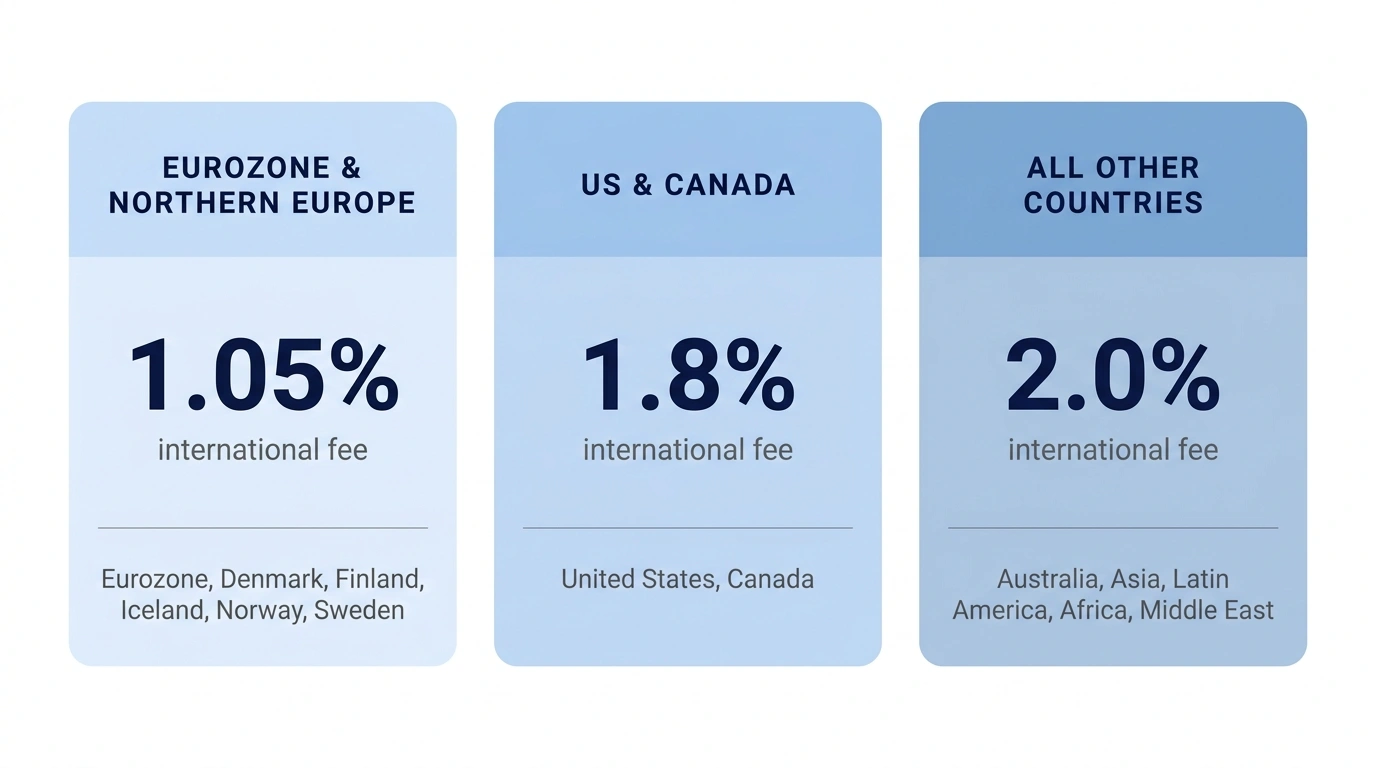
Charged on the full sale total (item + handling + postage + any tax) and taken automatically from your payout. Example: a £100 sale + £10 postage to a French buyer pays an extra 1.05% × £110 = £1.16. The same sale to a US buyer pays 1.8% × £110 = £1.98.
Private sellers, flat 3% (inc. VAT)
UK private sellers pay a flat 3% international fee on overseas sales. There's no regional tiering. On a £100 sale that's £3, charged on the total (item + postage + tax) and taken automatically.
To avoid it, block overseas delivery in your international selling policy. UK-only listings never get it.
Taxes eBay collects on your behalf, and how they affect the FVF base
In some countries (EU, UK, US, Australia and others), "marketplace facilitator" rules make eBay collect VAT, import or sales tax from the buyer at checkout and pay it over for you. You never see this money. Here's how each tax point hits you:
- Percentage fees land on the tax-inclusive total. The FVF, regulatory fee and international fee are calculated on the full sale total including any tax eBay collected, not just item + postage. The separate per-order fee remains a fixed 30p or 40p, depending on the order total and category.
- UK VAT sits inside your price. If you're VAT-registered, VAT has to be in the listed price (you can't add it after sale), so the FVF lands on the VAT-inclusive total too.
- Import duties are the buyer's problem. Where eBay doesn't pre-collect, the buyer may get a customs bill on arrival. Say so in your listings, surprise bills trigger negative feedback.
- GSP and eIS handle import charges. eBay is replacing the Global Shipping Programme with eBay International Shipping in phases, so the exact checkout and fee treatment depends on which programme your account and order use.
- Income tax is separate. You still owe HMRC income tax (or corporation tax) on your profit. Model it with the Sole Trader vs Ltd calculator. Near the £90k VAT threshold, the VAT Strategy Calculator compares normal VAT accounting, Flat Rate and Margin Scheme.
Performance surcharges, Below Standard and "Very high" INAD
Two FVF surcharges kick in if your performance drops below eBay's published bars. eBay checks both on the 20th of each month, then applies them to next month's sales. Here's what each costs and what triggers it:
| Surcharge | Added to variable FVF | What triggers it | Doesn't apply when |
|---|---|---|---|
| Below Standard | +6 points; +7 after 4+ consecutive months | Transaction defect rate above 2%, or cases closed without seller resolution above 0.3%. A 9.9% Books FVF initially becomes 15.9%. After four or more consecutive months Below Standard, the higher rate lasts until your seller level returns to Above Standard or higher. | - |
| "Very high" INAD (Item Not As Described) | +4 points; +5 after 4+ consecutive months | A "Very high" INAD rating in affected categories, measured against peers in your Service Metrics dashboard (Service Metrics policy). After four or more consecutive months, the higher rate lasts until the rating improves to High or better. | Fewer than 10 INAD requests were opened against you, or your INAD rate is under 1% in that category. |
Below Standard costs you more than the surcharge. On top of the +6pp (or +7pp after four consecutive months), expect:
- Lower Best Match visibility
- Restricted access to Promoted Listings campaigns
- Possible payment holds and selling limits
- Downgrade to a Basic Shop after 60+ days (if you held a Featured or Anchor Shop)
- Permanent selling restrictions, usually after 2 consecutive months, sooner for fraud or buyer-safety concerns
One more rating to watch, "Very high" Item Not Received (INR). It adds no surcharge. But eBay shows buyers longer delivery estimates in the affected categories, slowing your sell-through. Both ratings reset at the next check once you recover. Source: eBay Seller Centre, Seller standards & metrics.
Other situational fees, disputes, currency conversion, two-category, Classified Ads
A few fees only apply in certain cases. Know them before they hit an invoice:
- Dispute fee, £14 ex-VAT (business) / £16.80 inc-VAT (private). A buyer raises a payment dispute (usually a chargeback). If eBay finds you at fault, you pay this on top of the refund. Win the dispute and you pay nothing. It's the same £14 charge: business fees are shown ex-VAT, while private fees are shown inc-VAT; eligible input VAT may be reclaimable under normal VAT accounting.
- Currency conversion, 2.5%. List on a non-UK site (eBay.de, eBay.com) and eBay converts the foreign-currency fees and payout at the wholesale rate plus 2.5%. This applies to private and business sellers.
- Two-category listing, business pays the higher FVF; private pays 35p. Business: eBay charges the higher of the two category rates (a guitar in Music 9.9% and Musical Instruments 10.9% pays 10.9%) and doubles the listing fee. Private: a flat 35p upgrade, no FVF.
- Classified Ad format, flat listing fee, no FVF. Three categories only. There's no Final Value Fee and no Regulatory Operating Fee, just one up-front charge: Business, Office & Industrial £8.69; Property £30.43; Holidays & Travel £13.04. The deal closes off eBay; eBay only hosts the listing.
Off-platform contact still triggers FVF
Swap contact details with a buyer off eBay (email, phone, WhatsApp) to close a sale and eBay can still charge the FVF. It applies to the higher of the fixed price, auction start price, Buy It Now, reserve, or the price you agreed. Their logic: they introduced you. That's why Classified Ads, which send deals off eBay on purpose, use a different model.
Fee credits, when eBay refunds your fees on cancellations & refunds
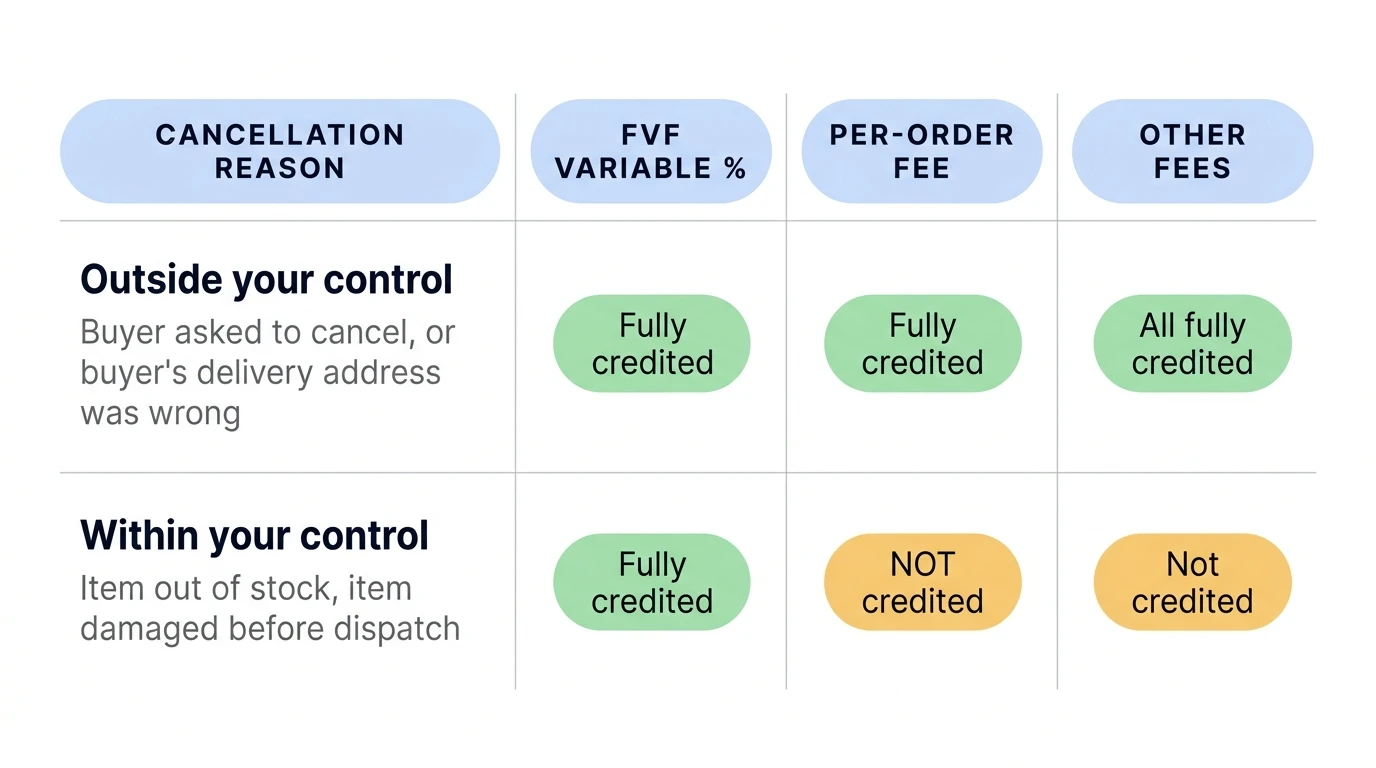
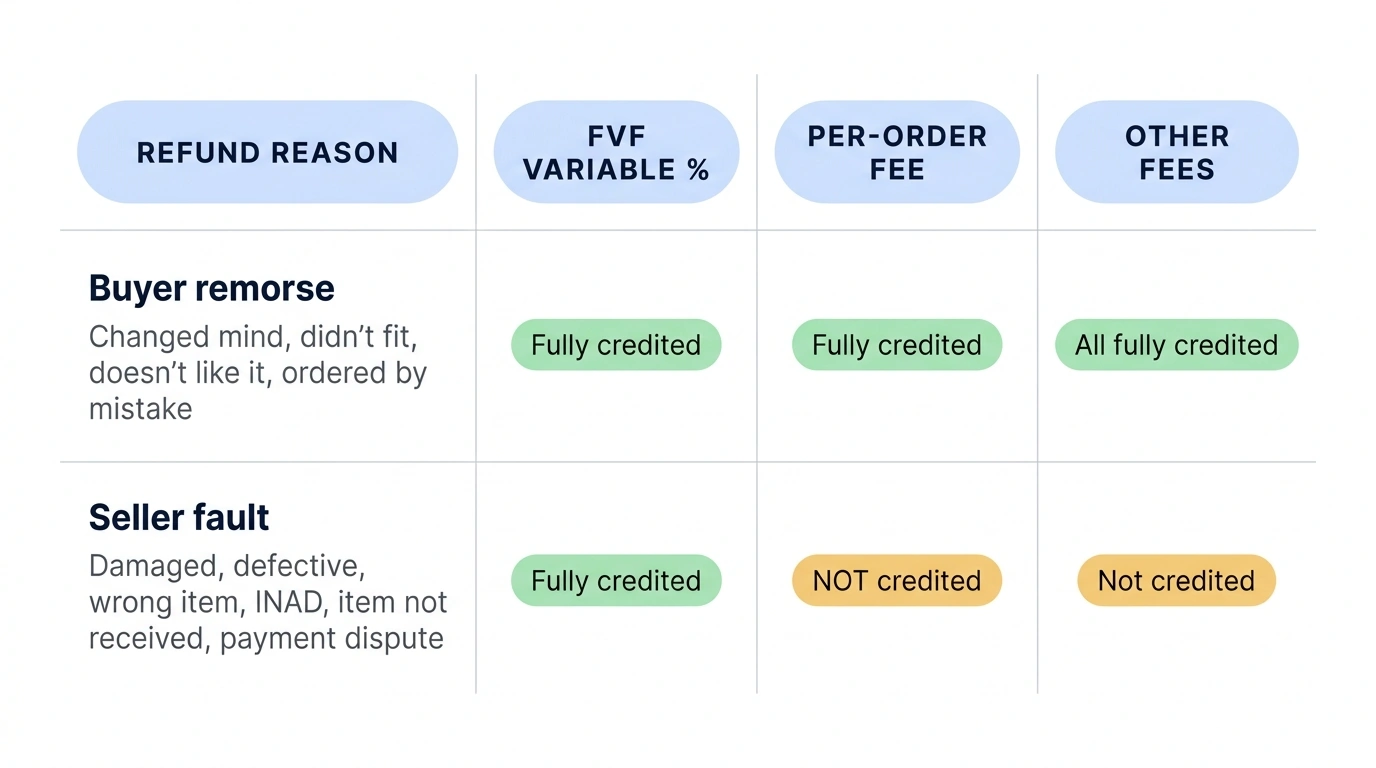
When a sale falls through, a cancelled order, refund, return or payment dispute, you may get some or all of your fees back. The key point: the 30p/40p per-order fee isn't always refunded. Whether you get it back depends on whose fault the cancellation or refund was.
This section covers what comes back. For the how-to side, cancelling without a transaction defect, which reasons cost you, and the 3-day buyer-request window, see the cancelling an eBay listing in the UK guide.
Cancelled orders, what comes back
Refunds, same logic, two tiers
Partial refunds, credits scale with the refund
Issue a partial refund and your eligible fee credits match the amount you refund. Refund the buyer 20% of the sale and you get back 20% of the eligible fees. Which fees count still depends on the buyer-fault vs seller-fault split above.
Listing fee credit when you relist an unsold or fallen-through item
Didn't sell first time, or the sale fell through? eBay will credit the listing fee on your relist, but only if you meet all of these:
- The item sells after you relist it (no sale, no credit)
- Original and relist use the same format, auction-style or fixed price (Classified Ads don't qualify)
- You use eBay's Relist tool, not a copy-paste new listing
- You relist within 90 days of the original ending
- It's the first manual relist of the item
- The start price isn't higher than the original
- You haven't added a Reserve Price on the relist
Listings removed by eBay
If eBay removes one of your listings, how your fees are credited depends on why:
- Unauthorised account access (account compromise): your listing fees and any final value fees are credited automatically.
- Policy violation: credit is decided case-by-case, and repeat violations count against you.
Currency conversion + refunds, the 120-day rule
If eBay converted currency on the original sale (say you sold on eBay.de in EUR but were paid in GBP), a refund issued within 120 days uses the original sale's exchange rate, not today's. After 120 days, today's rate applies, which can leave a gap between what the buyer gets and what comes off your account. Dispatch cleanly to avoid late refund disputes on cross-site sales.