Best Selling Items on eBay UK (July 2026): What Sells, and How to Prove It
eBay publishes no official UK best-sellers league table, so most 'top 10' lists are guesswork. Here is what eBay's own public data actually shows about the best selling items on eBay UK in 2026, plus the exact research workflow (sold listings filter, Product research, sell-through rate) to prove demand before you buy stock.
Quick answer
The best selling items on eBay UK in 2026 cluster in four areas: pre-loved fashion and trainers, consumer tech (phones, consoles and refurbished electronics), collectables and trading cards, and vehicle parts and accessories. eBay publishes no official UK best-sellers league table, so treat any exact “top 10” with suspicion: prove demand yourself with the free sold listings filter or the Product research tool in Seller Hub before you spend a penny on stock.
Search “best selling items on eBay UK” and you’ll find pages of recycled listicles quoting sales figures that eBay has never published. This guide takes the opposite approach. Every market claim below traces to a citable public source, mostly eBay’s own press releases and official help pages, and everything else is a method you can run yourself in ten minutes. Because “what sells” moves, the snapshot sections are dated and reviewed quarterly: this page reflects the position as of 6 July 2026.
By the end you’ll know which categories the public data genuinely supports, how to research demand with eBay’s Product research tool (the one many sellers still call Terapeak) and the sold listings filter, how to calculate a sell-through rate, and how to judge whether a flip is worth it after fees and postage, in pounds, with the working shown.
What sells best on eBay UK right now (July 2026)
Section last reviewed: 6 July 2026. We re-check the public sources each quarter and update the “Updated” date at the top of this post when anything changes.
Here is what eBay’s own published data supports, category by category:
- Pre-loved fashion is the UK’s biggest second-hand engine. eBay’s 2025 Recommerce Report (published November 2025, surveying more than 27,000 people) found UK shoppers buy pre-loved more often than any other market surveyed, with nearly half (46%) buying at least once a month, and clothing the most-bought pre-loved category (bought by 72% of pre-loved shoppers).
- Pre-loved and refurbished tech is the growth engine. The same report found 35% of UK consumers now buy pre-loved tech, putting it in the top three UK recommerce categories alongside fashion and books.
- Books remain a top-three second-hand category. Low glamour, steady demand, and cheap to post.
- Collectables and toys had a breakout 2025. eBay’s global “Collected” 2025 round-up reported Jellycat items sold up 270% year on year, Smiski figures up 230%, and searches for Labubu up 2,600% (global figures, not UK-specific).
- Vehicle parts and accessories are the quiet workhorse. eBay doesn’t publish UK volume figures here, but it maintains a dedicated parts-and-accessories selling experience with compatibility (fitment) data, and replacement demand never really stops. Treat this one as “evergreen but verify per part”.
One honest caveat before the deep-dives: these are demand-side signals. A category being popular with buyers does not make every item in it profitable for you. That depends on what you pay for stock, the fees on your account type, and postage, which is exactly what the rest of this guide covers.
Where this data comes from (and what we refuse to claim)
eBay does not publish a UK sales league table. There is no official “most sold items on eBay UK” list, no public per-category unit counts, and no API that hands out marketplace-wide totals to bloggers. So any article giving you a numbered chart of exact best sellers is either quoting eBay’s occasional press highlights or making it up.
This guide limits itself to three kinds of evidence:
- eBay’s own publications: the annual Recommerce Report, the “Collected” collectables round-up, and the UK press room. These give directional category trends with real, attributable figures.
- eBay’s official help pages: for every mechanic described here (Product research, sold listings, fees), so the “how” is grounded in current documentation rather than folklore.
- Your own research: the only source that can tell you whether a specific item at a specific buy price is worth it. The next three sections are that workflow.
How to research demand with Product research (Terapeak)
Product research is eBay’s built-in market research tool, found under the Research tab in Seller Hub. Longtime sellers know it as Terapeak, the standalone product eBay acquired and folded in. Per eBay’s help page, it gives you access to the last 3 years of eBay sales data for millions of items, including:
- Sales trends and average sold prices
- The sold price range (not just the average)
- Average postage costs and how many listings offered free postage
- Sell-through rate, for searches covering items sold in the last 90 days
- The total number of sellers who sold that item
- The selling format items sold in (auction vs fixed price)
Two details make it strictly better than eyeballing search results. First, it reaches back up to 3 years, while eBay’s completed-listings search only covers roughly the last 90 days, so it’s the only way to see seasonality. Second, it shows the actual price an item sold for even when the seller accepted a Best Offer, which the public sold listings view hides.
Here’s the workflow I run on every sourcing idea:
- Open Seller Hub > Research > Product research and search the exact product, e.g.
iPhone 13 128GB. Results match your keywords precisely, so be as specific as you would be when listing. - Set the date range to the last 90 days for current demand. Note the sell-through rate, average sold price and number of sellers.
- Clean the results with search logic:
-cover -casestrips accessory noise (a minus sign or “AND NOT” excludes a keyword), and(64GB OR 128GB)broadens across variants you’d happily stock. - Apply filters for condition (used prices and new prices are different markets), category, and seller location (UK) so you’re benchmarking against listings a UK buyer would actually compare you with. You can also filter by MPN, EAN, UPC or ePID for exact-product runs.
- Re-run the search with the date range set to 1 to 3 years. You’re looking for the shape of the curve: steady, seasonal, rising, or a spike already falling back to earth.
- Write down three numbers before you buy anything: average sold price, sell-through rate, and the number of competing sellers. They feed the five tests below.
Sourcing insights for Shop subscribers
Business sellers with an eBay Shop subscription also get Sourcing insights inside the Research tab: it surfaces categories with high demand but low inventory on eBay, and sold single-stock listings you could restock competitively. If you already pay for a Shop, it’s included, so use it. Access and features can change, so check eBay’s Product research help page for the current position on your account type.
The sold listings filter: free demand research in 5 steps
No Seller Hub? The sold listings filter does 80% of the job from the normal ebay.co.uk search page, and it’s free to everyone. eBay’s own pricing guidance points sellers at exactly this method:
- Search your item on ebay.co.uk exactly as a buyer would, e.g.
Nintendo Switch OLED console. - In the filters, tick Sold items. (You can also reach this via Advanced Search by choosing completed listings; sold items are the completed listings that actually found a buyer.)
- Remember the window: completed-listings results only cover items that ended in roughly the last 90 days. You’re seeing a quarter’s demand, not a year’s.
- Sort by most recent and count: how many identical (or near-identical) items sold per week? One a day is a business; one a month is a hobby.
- Note the sold prices, then flip the filter off and compare with what active listings are asking. The gap between those two numbers is where most bad buying decisions live.
Two traps in sold-price data
First, listings that sold via Best Offer display the original price, not the lower accepted amount, so sold prices can read higher than reality (Product research shows the true accepted price). Second, for UK private sellers, the price buyers see includes eBay’s Buyer Protection fee, which the seller never receives. Both push the apparent “market price” above what the seller was actually paid, so build in a margin of error before you commit to stock.
Sell-through rate: the one number that matters
If you take a single metric from this page, take this one. The sell-through rate (STR) is the number of sold listings divided by the number of active listings, times 100. It answers the question a “best sellers” list never can: is supply or demand winning for this exact item?
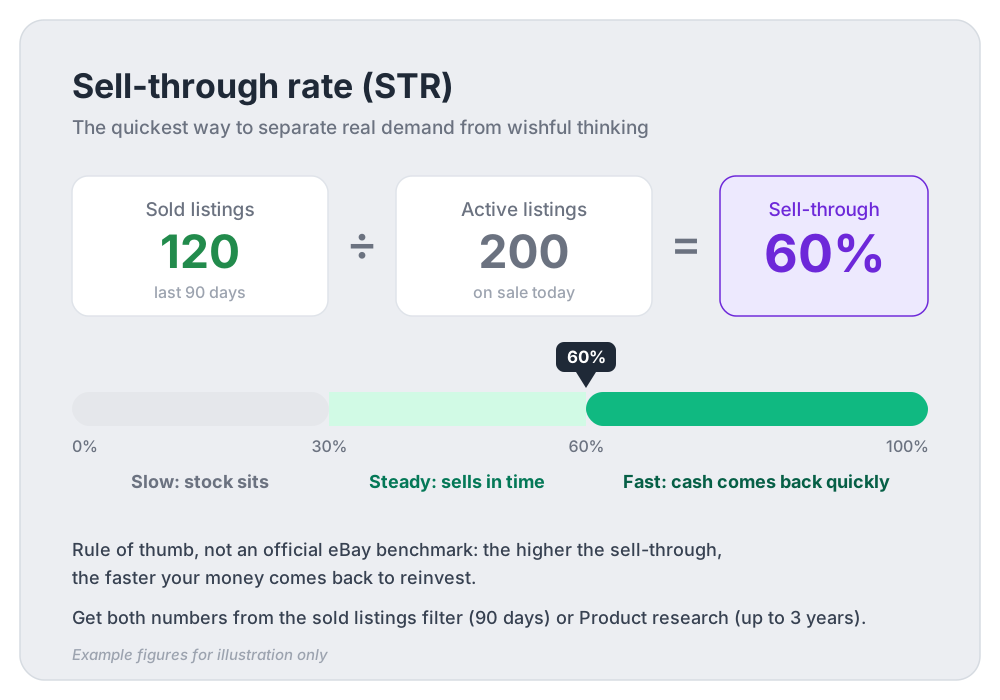
Worked through: say the sold listings filter shows 120 sold in the last 90 days and there are 200 active listings today. 120 ÷ 200 × 100 = a 60% sell-through rate. Roughly speaking, listings of this item have better-than-even odds of selling within a quarter. Flip the numbers (20 sold, 300 active, STR under 7%) and you’re looking at a saturated item where your money would sit on a shelf.
The bands on the diagram are a reseller rule of thumb, not an eBay benchmark: eBay doesn’t publish an official “good” STR. What matters is cash velocity. A 40% margin item you sell weekly beats a 100% margin item you sell twice a year, because the weekly item lets you recycle the same capital a dozen times. Product research calculates STR for you on searches covering the last 90 days; for anything else, count it by hand with the method above.
What makes a good flip: the five tests
A “good flip” is not an item, it’s a set of conditions. Run every candidate, whether it’s a car boot find or a wholesale pallet, through these five tests:
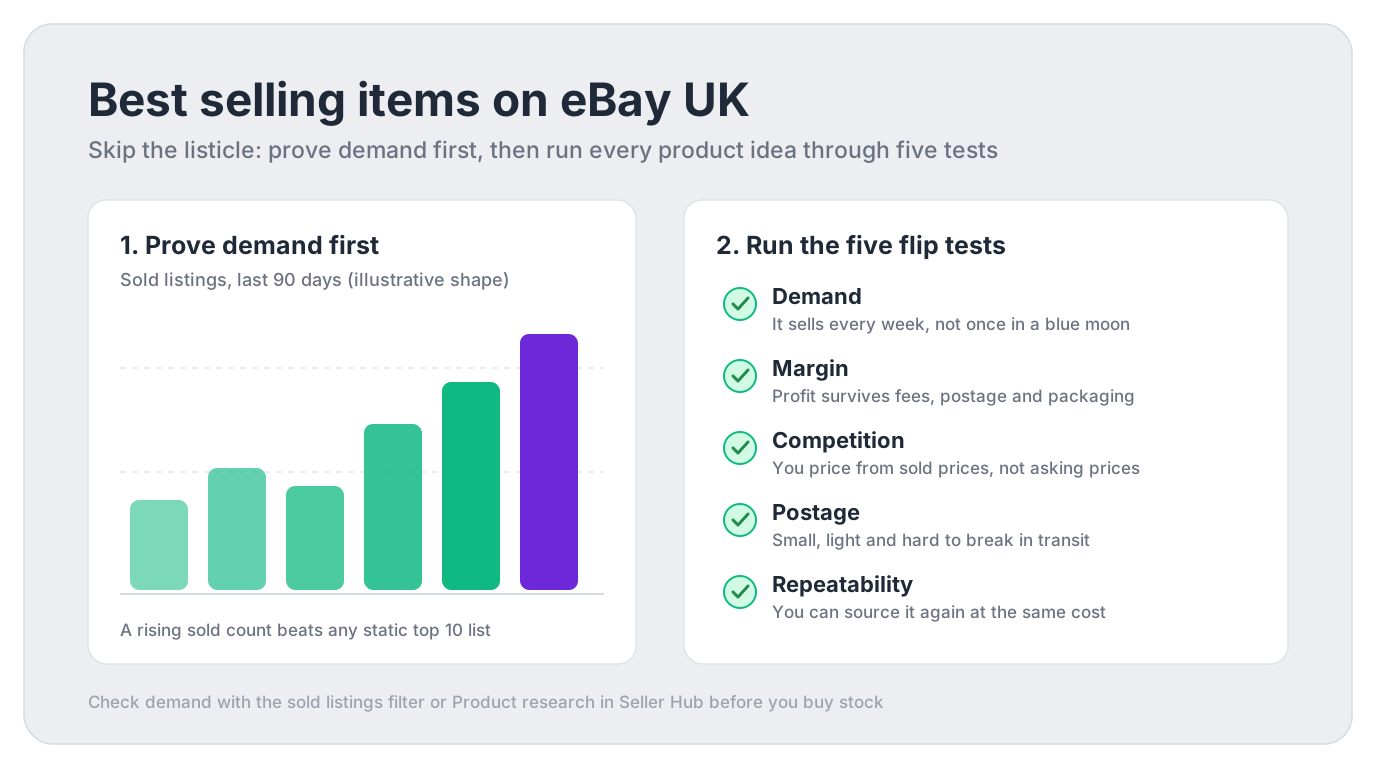
- Demand: multiple sold listings per week over the last 90 days, and a 3-year trend that isn’t falling off a cliff. Weekly sales mean the market will absorb your stock too.
- Margin: after fees, postage and packaging, you keep a profit that pays for your time. A common reseller heuristic is to target a sale price of roughly three times your buy cost for low-value items; on higher-value items a smaller multiple works because the absolute profit per sale is bigger.
- Competition: you price from sold prices, and there’s room for you at that price. If ten established sellers are already at the sold-price floor, you win nothing by becoming the eleventh.
- Postage: small, light and durable wins. An item that fits a Royal Mail large-letter or small-parcel format is cheaper to post and less likely to arrive broken than the glass lamp with the same margin on paper. Postage damage becomes returns, and returns eat flips.
- Repeatability: a one-off bargain is nice; a repeatable source (regular auction lots, retail clearance cycles, a wholesaler) is a business. When you find a winner, the question is always “can I get ten more?”
Worked example: a £45 console flip after fees
Numbers make this concrete. Suppose you find a games console bundle at a car boot sale for £45, and the sold listings filter shows comparable bundles selling at around £110 with free postage (illustrative figures; run your own search on the exact model and condition).
As a UK private seller
- UK-based private sellers currently pay no final value fee and no regulatory operating fee when items sell, and get 300 free listings a month (35p per extra listing after that), per eBay’s private seller fee page. Optional upgrades and overseas delivery (a 3% international fee) cost extra.
- The catch: for private listings, buyers pay eBay’s Buyer Protection fee, and it’s baked into the price they see. If the sold price you benchmarked (£110) was a private listing, the seller actually set a price of roughly £105: the fee is 10p per item plus 7% of the first £20 and 4% of the portion from £20 to £300 (the rate drops to 2% from £300 to £4,000, and nothing above that), which adds about £5 here.
- So price at £105, buyer sees roughly £110. Assume £7 for a tracked courier (Evri or Royal Mail, size-dependent) and £1.50 packaging.
- Net: £105 received, minus £45 stock, £7 postage, £1.50 packaging = about £51.50 profit, roughly a 114% return on the £45 outlay.
As a business seller
- Business sellers pay a final value fee that varies by category, plus a per-order fee (30p on orders of £10 or less, 40p above £10) and a 0.35% regulatory operating fee, per eBay’s business seller fee page (dated 12 February 2026; business fees are shown excluding VAT).
- Video Game Consoles carry a 6.9% final value fee on the portion of the sale up to £400. Buyer Protection is included at no cost to buyers on business listings, so you can list at the full £110.
- Fees on a £110 sale: 6.9% = £7.59, plus £0.40 per-order, plus 0.35% regulatory = £0.39. Total about £8.38 before VAT on fees.
- Net: £110 minus £8.38 fees, £45 stock, £7 postage, £1.50 packaging = about £48 profit before VAT on fees and before tax.
Run your own numbers in our free eBay fee calculator, and see the full breakdown of every charge in our UK eBay selling fees guide.
Category deep-dives: the best things to sell on eBay UK
Section last reviewed: 6 July 2026. Demand notes cite eBay’s published data; fee notes cite the business seller fee schedule dated 12 February 2026.
Pre-loved fashion and trainers
The strongest publicly evidenced category in the UK. eBay’s 2025 Recommerce Report puts UK shoppers at the front of the global pre-loved shift, with clothing the most-bought second-hand category. What that means in practice: branded outerwear, discontinued lines, quality denim and well-photographed vintage move consistently, and the buyer pool skews younger, which supports trend-led stock.
Two seller-side notes. Sizing and condition disputes drive fashion returns, so measure garments flat and photograph every flaw. And for business sellers, the fee maths shifts inside the category: Clothes, Shoes & Accessories carries an 11.9% final value fee, but trainers with an item price of £100 or more drop to 7%, which materially changes which shoes are worth sourcing.
Consumer tech: phones, consoles and refurbished electronics
The Recommerce Report’s standout growth story: 35% of UK consumers now buy pre-loved tech. Phones, tablets, consoles, headphones and hi-fi separates all have deep, liquid markets with high sell-through on accurately described stock. Fees reward the category too: for business sellers, Mobile & Smart Phones carry a 6.9% final value fee on the portion up to £1,000, and Video Game Consoles 6.9% up to £400.
The craft here is description discipline: test everything, state battery health and storage capacity, include the model and MPN or product identifiers so eBay matches you to the right catalogue product, and photograph actual condition. Honestly listed faulty tech (“for parts, not working”) also sells; a dead console has a real market among repairers, and an honest listing beats a returned “working” one every time.
Books and media
A top-three UK recommerce category per eBay’s report, and the friendliest on-ramp for new sellers: cheap to source, light to post, and honest to grade. Margins per unit are small, so the flip test that matters most is postage: stock that ships as a Royal Mail large letter keeps costs down, and combined-postage settings help on multi-book orders. Skip mass-market paperbacks; the money is in niche non-fiction, technical manuals, first editions and completed series sold as bundles. For business sellers the final value fee is 9.9%, and note the per-order fee bites hardest on sub-£10 sales.
Collectables, toys and trading cards
eBay’s global “Collected” 2025 round-up documented the boom: Jellycat sales up 270%, Smiski up 230%, Labubu searches up 2,600%. Collectables reward genuine expertise more than any other category; if you can grade a trading card or spot a genuine Jellycat, information asymmetry is your margin.
The equally documented risk is velocity: what spikes 2,600% can fall as fast, and the people who bought trend stock at the peak become the motivated sellers you see six months later. Use Product research’s 3-year view to see where on the curve you are before buying in, and prefer evergreen collectables (long-running card games, retro gaming, established figure lines) over whatever is viral this month. Business-seller final value fees run at 10.9% for Toys & Games and most Collectables.
Vehicle parts and accessories
No public league table, but the structural logic is hard to beat: cars break, parts are discontinued, and a buyer with a broken car is not a price-sensitive browser. Breakers’ lots, discontinued OEM parts and accessories for common UK models sell steadily. eBay’s parts experience is built around compatibility, so complete the fitment data and part numbers on every listing; a correct MPN is the difference between appearing in a buyer’s “fits my car” search and not existing. For business sellers the final value fee is 9.5% on the portion up to £750. Watch the postage test: body panels fail it, sensors and trim clips pass it easily.
Home, garden and DIY tools
Steady rather than glamorous, and fee-favoured in places: for business sellers, Appliances and DIY Tools & Workshop Equipment carry a 6.9% final value fee on the portion up to £400, against 11.9% for general Home, Furniture & DIY. Power tools from reputable brands hold value and sell fast second-hand; bulky furniture usually fails the postage test unless you offer collection in person, which eBay supports.
How eBay fees change what “best selling” means
The same £100 sale leaves a different profit depending on who you are and what you sold. Since these fee levels decide whether a “best seller” is a best earner, they belong in any honest version of this guide:
- UK private sellers: currently no final value fees and no regulatory operating fee; 300 free listings a month, then 35p per listing. Buyers pay the Buyer Protection fee on top of your price. Optional listing upgrades and a 3% international fee on overseas deliveries still apply.
- Business sellers: a category-dependent final value fee on the total sale (item plus postage), a per-order fee (30p up to £10, 40p above), and a 0.35% regulatory operating fee. Fees are quoted excluding VAT.
| Category | Final value fee | Worth knowing |
|---|---|---|
| Clothes, Shoes & Accessories | 11.9% | Women's bags and some subcategories differ |
| Trainers (item price £100+) | 7% | 11.9% below £100; item price excludes postage |
| Mobile & Smart Phones | 6.9% up to £1,000 | 3% on the portion above £1,000 |
| Video Game Consoles | 6.9% up to £400 | 2% on the portion above £400 |
| Books, Comics & Magazines | 9.9% | Per-order fee stings on sub-£10 sales |
| Toys & Games / most Collectables | 10.9% | Reduced 10p per-order fee on some sub-£10 collectables orders |
| Vehicle Parts & Accessories | 9.5% up to £750 | 3% on the portion above £750; tyres and some parts are lower |
| Appliances / DIY Tools & Workshop Equipment | 6.9% up to £400 | General Home, Furniture & DIY is 11.9% up to £500 |
Fee schedules change; always confirm against eBay’s current fee page before building a sourcing plan around a rate. And once you’re selling in any volume, per-item profit tracking stops being optional: it’s how you learn that your “best selling” line is quietly your third-best earner. That’s the exact problem DashVue exists for: it pulls every eBay fee, postage cost and refund into a net profit figure per sale, from £8.99/month with a 7-day free trial and no card required.
Common mistakes when chasing best sellers
- Buying from asking prices. Active listings tell you what sellers hope to get. Only sold listings (and Product research) tell you what buyers pay.
- Ignoring sell-through. “They sell for £80!” means little if 300 are listed and 5 sold last quarter.
- Boarding a trend at the top. By the time a collectable is in the news, early sellers are exiting. The 3-year trend view exists to protect you from this.
- Forgetting fees differ by category and account type. A trainers sale at £105 and one at £95 sit on different fee rates for business sellers. Small price positioning choices change real margin.
- Misreading private-seller sold prices. The displayed price includes the Buyer Protection fee the seller never received. Benchmark a few pounds under what you see.
- No repeat source. A profitable one-off teaches you nothing you can scale. Prioritise items you can source again.
- Ignoring seasonality. Board games in November and bike parts in April are different markets from the same items in the opposite month. This is exactly what Product research’s multi-year view is for.
FAQ: best selling items on eBay UK
What is the most sold item on eBay UK?
eBay doesn’t publish an official most-sold list for the UK, so nobody outside eBay can name one item honestly. What the public data supports is category-level: pre-loved fashion is the biggest UK second-hand category, with tech and books alongside it, and collectables had standout growth in 2025. For any specific item, the sold listings filter gives you a real 90-day answer in minutes.
How do I find the top selling items in a category?
Use Product research in Seller Hub: search by category rather than keyword, apply the condition and location filters, and sort what sold over your chosen date range. The sell-through rate and number of sellers tell you whether the demand has room for you. Without Seller Hub, run buyer-side searches with the Sold items filter and count what actually moved in the last 90 days.
Is Terapeak (Product research) free?
Product research lives in the Research tab of Seller Hub, and Sourcing insights is included for business sellers with an eBay Shop subscription. eBay has changed access rules over the years, so check the Product research help page for the current position on your account type.
What sells fastest on eBay UK?
Whatever has a high sell-through rate in your niche: there is no universal answer. As a pattern, consumables, in-demand tech, needed replacement parts and trend collectables at the right point of the curve turn over quickest, while commodity items with hundreds of active listings sit. Measure STR before buying rather than trusting a list, this page’s included.
Do private sellers pay fees when an item sells?
UK-based private sellers currently pay no final value fee and no regulatory operating fee on domestic sales; buyers instead pay a Buyer Protection fee that is included in the displayed price. You still pay for optional listing upgrades, a 3% international fee if the buyer’s delivery address is outside the UK, and 35p per listing beyond your 300 free listings each month. Vehicles and a few formats are excluded, so check eBay’s private seller fee page for your case.
How much can I sell before paying tax?
Selling regularly for profit can make you a trader in HMRC’s eyes even at modest volumes. The thresholds and reporting rules deserve their own page, so read our guide to how much you can sell on eBay UK before paying tax before scaling up.
Sources
- eBay 2025 Recommerce Report and the UK press release (November 2025): UK pre-loved buying frequency, fashion, books and tech figures.
- eBay: the collectibles that defined 2025 (December 2025): global Jellycat, Smiski and Labubu trend figures.
- eBay help: Product research : data coverage, metrics, filters, search logic and Sourcing insights.
- eBay help: Pricing your items : the completed and sold listings research method.
- eBay help: Fees for private sellers and Fees for business sellers : all fee figures quoted above.
- eBay help: Buyer Protection fee : the fee bands included in prices on UK private listings.
Fee levels, tool access and category rules change over time. Figures here reflect the cited pages as of 6 July 2026; always confirm against eBay’s live help pages before making decisions that depend on an exact rate.