Margin vs Markup: The Difference Explained for UK eBay Sellers (2026)
Markup divides your profit by cost; margin divides it by the selling price. Mix them up and your “30% profit” quietly shrinks. Every formula, a conversion table, and worked GBP examples with real eBay fee maths for UK resellers.
Quick answer
Markup is your profit as a percentage of what the item cost you; margin is the same profit as a percentage of the selling price. Because the selling price is always the bigger number, margin is always the smaller percentage: a 50% markup is only a 33.3% margin. On a £30 sale that cost you £20 all-in, the £10 profit is 50% of cost (markup) but 33.3% of price (margin).
Mixing up markup and margin is probably the most expensive maths mistake a reseller can make, because it fails silently. Add 30% to your costs, call it “30% profit”, and you’re actually running a 23.1% margin before eBay takes a penny; after final value fees it can drop into single digits. Nothing breaks, no warning appears, you just keep less money than you think on every single order.
This guide gives you the plain-English difference between markup and margin, both formulas, a conversion table you can bookmark, and worked GBP examples that include real eBay UK fees in the calculation, because for an eBay seller a profit formula that ignores fees is fiction. The fee figures come from eBay’s business seller fee schedule and private seller fee page.
Margin vs markup: the difference in one minute
Both numbers describe the same pound profit. The only thing that changes is what you divide it by:
- Markup divides profit by cost. It answers: “how much did I add on top of what I paid?”
- Margin divides profit by the selling price. It answers: “what share of the money the buyer handed over do I actually keep?”

Because the denominator differs, the two percentages are never equal on a profitable sale, and the gap widens as prices rise relative to cost. A 100% markup (buy for £10, sell for £20) is a 50% margin. A 300% markup is a 75% margin. There is no markup that produces a 100% margin, because that would mean the item cost you nothing.
What is markup?
Markup is the amount you add to an item’s cost to reach its selling price, expressed as a percentage of that cost. It’s the natural language of sourcing: you’re standing at a car boot sale or scrolling a wholesaler’s price list, you know what the item costs, and you’re working forwards to a price.
To calculate markup:
- Work out your profit: selling price minus total cost. Total cost means everything: stock, postage label, packaging, not just what you paid for the item.
- Divide that profit by the total cost.
- Multiply by 100 to get a percentage.
Example: you buy a jacket for £8, spend £3 getting it posted and packed, and sell it for £22. Profit is £11, total cost is £11, so markup is £11 ÷ £11 = 100%. You doubled your money. If a reseller tells you they “work on 2x” or “3x”, that’s markup talk: 2x = 100% markup, 3x = 200% markup.
What is profit margin?
Profit margin is your profit expressed as a percentage of the selling price. It’s the language of accounts, comparisons and business health: out of every £100 of sales, how many pounds do you keep?
Two versions matter for resellers:
- Gross margin = (selling price minus cost of goods) ÷ selling price. It ignores fees and postage, which makes it flattering and, on its own, close to useless for an eBay seller.
- Net margin = (selling price minus every cost: stock, postage, packaging, eBay fees) ÷ selling price. This is the number that decides whether your reselling is a business or an expensive hobby.
Same jacket as above: £22 sale, £11 total cost, £11 profit. Margin is £11 ÷ £22 = 50%. Notice the pattern: the 100% markup became a 50% margin. Same jacket, same £11, different denominator.
The two formulas, plus how to convert between them
The core pair:
- Markup % = (selling price − cost) ÷ cost × 100
- Margin % = (selling price − cost) ÷ selling price × 100
And the two conversion formulas, which are worth pinning above your desk:
- Margin = markup ÷ (1 + markup). A 50% markup: 0.5 ÷ 1.5 = 0.333 = 33.3% margin.
- Markup = margin ÷ (1 − margin). A 40% margin: 0.4 ÷ 0.6 = 0.667 = 66.7% markup.
Finally, the two pricing formulas that follow from them:
- Price from a target markup: price = cost × (1 + markup). Cost £12 at a 75% markup: 12 × 1.75 = £21.
- Price from a target margin: price = cost ÷ (1 − margin). Cost £12 at a 40% margin: 12 ÷ 0.6 = £20. Dividing, not multiplying, is the whole trick: to protect a margin you divide by what’s left of the price after profit.
A 30-second sanity check
Margin can never reach 100% and markup can exceed 1,000%; if your “margin” is bigger than your markup, you’ve swapped the formulas. Markup is always the larger of the two numbers on any profitable sale.
Markup to margin conversion table
The middle column is what each common markup really earns you as a share of the price. The right column shows the selling price each markup produces on an item with a £20 total cost:
| Markup on cost | Equivalent margin | Price of a £20-cost item |
|---|---|---|
| 20% | 16.7% | £24.00 |
| 25% | 20% | £25.00 |
| 30% | 23.1% | £26.00 |
| 40% | 28.6% | £28.00 |
| 50% | 33.3% | £30.00 |
| 75% | 42.9% | £35.00 |
| 100% (2x) | 50% | £40.00 |
| 150% | 60% | £50.00 |
| 200% (3x) | 66.7% | £60.00 |
| 300% (4x) | 75% | £80.00 |
Two things jump out. First, at the modest markups typical of competitive new-goods categories (20% to 40%), the margin equivalent is dramatically lower than the markup number sounds. Second, the gap between the two shrinks as a proportion at high multiples, which is why car boot and charity shop flippers, who routinely run 200%+ markups, can afford to be casual about the distinction in a way that arbitrage and wholesale sellers cannot.
Worked eBay examples, with the fees in the maths
Textbook margin examples stop at “price minus cost”. On eBay there’s a third party in every transaction, so let’s do it properly. Note that eBay charges business sellers’ final value fees on the total amount of the sale including postage, not just the item price, which trips up a lot of margin spreadsheets.
Example 1: business seller, £30 board game
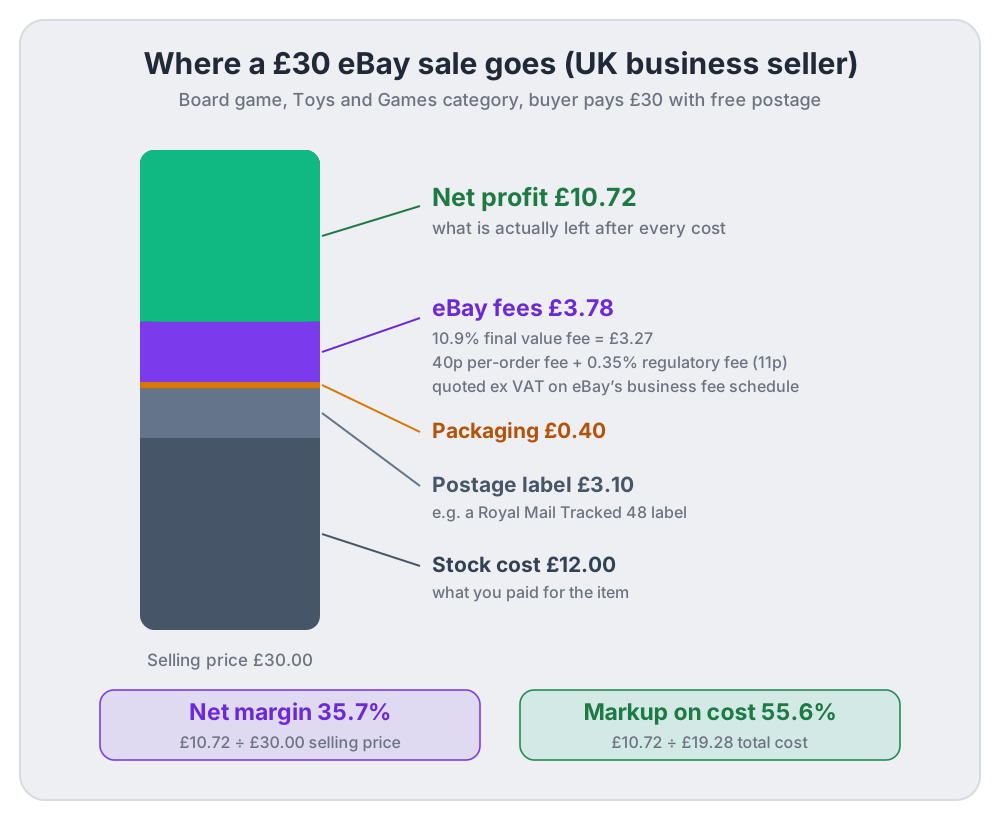
You’re a registered business seller. You buy a board game for £12, list it in Toys & Games (a 10.9% final value fee category on eBay.co.uk) at £30 with free postage, and send it with a £3.10 Royal Mail Tracked 48 label in a £0.40 mailer. Here’s the full calculation:
- Final value fee (variable part): 10.9% of the £30 total = £3.27.
- Per-order fee: the order is over £10, so £0.40 (it’s £0.30 for orders of £10 or less).
- Regulatory operating fee: 0.35% of £30 = £0.11.
- Total eBay fees: £3.78 (eBay’s business fee schedule is quoted excluding VAT; see the callout below).
- Total costs: £12.00 stock + £3.10 postage + £0.40 packaging + £3.78 fees = £19.28.
- Net profit: £30.00 − £19.28 = £10.72.
- Net margin: £10.72 ÷ £30.00 = 35.7%. Markup on cost: £10.72 ÷ £19.28 = 55.6%.
Business fees are quoted excluding VAT
eBay’s business seller fee page states its fees exclude VAT, so the real cash cost of the £3.78 above is higher once VAT is added, and only VAT-registered sellers can reclaim it. Private seller fees, by contrast, are quoted inclusive of VAT. Build whichever applies to you into your margin maths, and check eBay’s current fee page before relying on any specific rate.
Example 2: private seller, £25 jacket
Since eBay UK made selling free for private sellers, the maths on the seller side got simpler: UK-based private sellers pay no final value fees and no regulatory operating fee when their items sell (vehicles excluded), and get 300 free listings a month, with a 35p listing fee for each extra listing beyond that.
- You pick up a jacket at a car boot for £8 and list it at £25 with free postage, inside your free listing allowance.
- It sells. You post it with a £2.60 Evri label in a £0.45 mailing bag.
- Total costs: £8.00 + £2.60 + £0.45 = £11.05. No eBay transaction fees.
- Net profit: £25.00 − £11.05 = £13.95.
- Net margin: £13.95 ÷ £25.00 = 55.8%. Markup: £13.95 ÷ £11.05 = 126%.
One competitive wrinkle: your buyer doesn’t see £25. Purchases from UK private sellers carry a Buyer Protection fee that eBay adds into the displayed price: a 10p flat fee per item, plus 7% of the item price up to £20, plus 4% of the portion from £20 to £300 (2% from £300 to £4,000, with no fee on any portion above £4,000). On your £25 jacket that’s £1.70, so buyers browse past a £26.70 price tag. Your margin is untouched, but you’re competing at the fee-inclusive price, which matters when you set yours.
Example 3: pricing backwards from a target margin
The most useful formula on this page: what price hits a chosen net margin after eBay’s percentage fees? Because the fees scale with the price, you fold them into the denominator:
Price = fixed costs ÷ (1 − target margin − fee percentage)
- Add up fixed costs: £9.00 stock + £3.10 postage + £0.40 packaging + £0.40 per-order fee = £12.90.
- Add up percentage fees: 10.9% final value fee + 0.35% regulatory operating fee = 11.25% = 0.1125.
- Apply the formula for a 30% net margin: £12.90 ÷ (1 − 0.30 − 0.1125) = £12.90 ÷ 0.5875 = £21.96.
- Check it: at £21.96, percentage fees are £2.47, total costs £15.37, profit £6.59, and £6.59 ÷ £21.96 = 30%. Exactly on target.
If you’d priced with the markup shortcut instead (£12.90 × 1.3 = £16.77), your realised net margin at that price works out at roughly 12%, well under half of what you were aiming at. Our free eBay fee calculator runs this exact fees-included calculation for your own numbers.
The 30% trap: how confusing markup and margin costs real money
Here’s the failure mode in full, because it’s worth seeing the pounds evaporate step by step. A business seller decides they want “30% profit” on an item with a £10 all-in cost:
- They add 30% to cost: £10 × 1.3 = £13 selling price. That’s a 30% markup.
- Before fees, the margin is already only £3 ÷ £13 = 23.1%, not 30%.
- Then eBay’s business fees land on the £13 total: a 10.9% final value fee (£1.42), the £0.40 per-order fee and the 0.35% regulatory operating fee (£0.05). Total: £1.87.
- Real net profit: £13 − £10 − £1.87 = £1.13. Real net margin: 8.7%.
The seller believes they earn 30p in the pound; they actually earn under 9p. One return postage label or one small price drop and the item trades at a loss. Multiply that by a few hundred orders a month and the gap between “30%” and 8.7% is a four-figure hole that never shows up anywhere until you calculate net margin properly.
Markup or margin: which should you use for pricing decisions?
Both, but for different jobs:
- Use markup when sourcing. Standing over a job lot, “can I sell this for at least double?” is a fast, cost-anchored filter. Markup is also what wholesale price lists and trade suppliers speak.
- Use margin when pricing and reviewing. Margin is fee-friendly (eBay fees are percentages of the price, so they subtract cleanly from a margin target, as in Example 3), it’s comparable across products at different price points, and it’s the number HMRC-facing accounts, lenders and any prospective buyer of your business will expect.
- Never mix them mid-calculation. The trap in the section above is always some version of setting a price with markup and reading the result as margin.
A decent rule of thumb: markup is for buying decisions, margin is for selling decisions. If the number will end up in a price, a report or a comparison, use margin.
Other profit formulas resellers actually need
Net profit per sale
Net profit = selling price − stock cost − postage − packaging − eBay fees − any other selling costs (promoted listings spend, listing upgrade fees, refunds). This is the raw input to every percentage on this page. If you track one number per order, track this one.
ROI (return on investment)
ROI = net profit ÷ total cash invested × 100. Here’s a secret hiding in plain sight: for a single flip, ROI and markup are the same calculation: profit divided by cost. When a reseller on YouTube brags about “300% ROI”, they’re quoting a markup figure, and you now know that’s a 75% margin. ROI earns its keep over time: £10 profit on £10 invested is a 100% ROI whether it took a week or a year, and the week version is a vastly better business. Always pair ROI with sell-through speed.
Break-even price
The lowest price at which you don’t lose money, with percentage fees included, is the target-margin formula with the margin set to zero:
Break-even price = fixed costs ÷ (1 − fee percentage)
Example 1’s board game: £15.90 of fixed costs (£12 stock + £3.10 postage + £0.40 packaging + £0.40 per-order fee) ÷ (1 − 0.1125) = £17.92. Any accepted offer under that is a guaranteed loss before you’ve even considered your time. Knowing your break-even before you enable Best Offer is one of the highest-value five-minute jobs in reselling.
Gross vs net, one last time
Gross margin (price minus stock cost only) is fine for spotting whether a product category is worth being in. Net margin (after postage, packaging and fees) is the only version that should ever drive a price. When you read “margin” anywhere on this site, including in DashVue itself, it means net.
Common mistakes (and how to avoid them)
- Setting prices with markup, reporting them as margin. The 30% trap above. Fix: price with the divide formula (cost ÷ (1 − margin)), never the multiply one, when a margin is the goal.
- Forgetting fees are charged on postage too. For business sellers the final value fee applies to the total amount of the sale including postage and any applicable taxes. Charging £3.50 postage doesn’t dodge the percentage; eBay takes its cut of that as well.
- Ignoring the per-order fee on cheap items. 30p on a £6 order is 5% of the sale by itself, on top of the category percentage. Low-price, high-volume models live or die on this line.
- Using the wrong fee schedule. Private sellers currently pay no final value fees on eBay UK; business sellers pay category final value fee rates (up to 14.9% in some categories) plus the extras, quoted ex VAT. Margin maths copied from a private seller’s spreadsheet will flatter a business account badly. Our complete eBay selling fees guide walks through every line.
- Costing the item but not the sale. Packaging, label printer paper, promoted listings percentages and returns all belong in “cost”. A 2% promoted listings rate comes straight off your net margin.
- Quoting ROI as if it were margin. They can differ by a factor of three or more. Know which one you’re looking at before acting on it.
- Working from gross margin all year, then meeting your accountant. If your records only show item cost against sale price, tax time is where the missing fees and postage surface all at once. Track net as you go.
How to track your real margin without a spreadsheet
Everything above is doable by hand for ten orders a month. At a hundred orders across three fee categories with mixed postage services, a manual margin spreadsheet is where good intentions go to die, and the errors always run in the flattering direction.
This is the exact problem DashVue was built for. It connects to your eBay account, pulls in every order, and deducts every fee line automatically: final value fees, the per-order fee, the regulatory operating fee, promoted listings charges, label costs, so each sale shows its true net profit and net margin rather than a number you hoped was right. The profit & loss reports roll those per-order margins up by product, so you can see which lines earn a 40% margin and which are 8% traps dressed as winners. Plans start from £8.99/month with a 7-day free trial and no card required, and every plan includes the full dashboard.
If you just want a quick one-off check, the free eBay fee calculator gives you fees, net profit and margin for a single sale in a few seconds.
Margin vs markup FAQ
Is a 30% markup the same as a 30% margin?
No. A 30% markup is a 23.1% margin. Markup divides profit by cost; margin divides the same profit by the (larger) selling price, so the margin figure is always smaller. To convert: margin = markup ÷ (1 + markup).
What is the profit margin formula?
Margin % = (selling price − total cost) ÷ selling price × 100. For an eBay seller, “total cost” should include stock, postage, packaging and all eBay fees; that gives you net margin, the version worth tracking.
How do I convert markup to margin?
Divide the markup by one plus the markup (both as decimals). 50% markup: 0.5 ÷ 1.5 = 33.3% margin. Going the other way, markup = margin ÷ (1 − margin), so a 25% margin needs a 33.3% markup.
What is a good profit margin for eBay resellers?
There’s no universal number: sourcing model and category economics dominate. Second-hand sellers sourcing from car boots and charity shops often run net margins above 50% because stock is cheap relative to price; sellers of new goods in competitive categories can be viable well below that on volume. The honest answer is to compute your own net margin per product, know your break-even, and judge each line against your time and capital rather than someone else’s benchmark.
Do eBay fees count in margin, and which fees?
Yes, always, or the number is fiction. For UK business sellers that means the category final value fee percentage (charged on the total sale including postage), the 30p/40p per-order fee, the 0.35% regulatory operating fee, plus any optional costs like promoted listings, all quoted ex VAT on eBay’s schedule. UK private sellers currently pay no final value fees, so their margin calculation is mostly stock, postage and packaging. Rates change, so check eBay’s official fee pages for the current figures.
Is margin calculated before or after VAT?
If you’re VAT registered, calculate margin on the net-of-VAT selling price, because the VAT portion was never your money. If you’re not registered, the full selling price is yours, but remember VAT is added on top of eBay’s business fees and you can’t reclaim it. If you’re approaching the registration threshold, read our £90k VAT threshold guide for eBay sellers before it reads you.
What is the profit formula for an eBay sale?
Net profit = selling price − stock cost − postage label − packaging − eBay fees − any advertising or upgrade fees − any refunds. Divide it by the selling price for net margin, or by your total costs for markup/ROI.
Sources
- eBay UK: Fees for business sellers (final value fee mechanics, per-order fee, regulatory operating fee, category rates, ex-VAT note).
- eBay UK: Fees for private sellers (free selling for UK private sellers, 300 free listings, 35p additional listing fee).
- eBay UK: Buyer Protection fee (fee bands added to private-seller item prices that buyers see).
eBay’s fee rates and structures change over time and vary by category and account type. The formulas here are permanent; always confirm the current percentages against eBay’s live fee pages before pricing on them.