eBay MC Codes Explained (UK): What the Warnings Usually Mean, and What to Do
People land on this page because they need action, not theory. This is a practical UK-focused explanation of MC codes and the most common real-world responses based on eBay's own wording and seller-side notices.
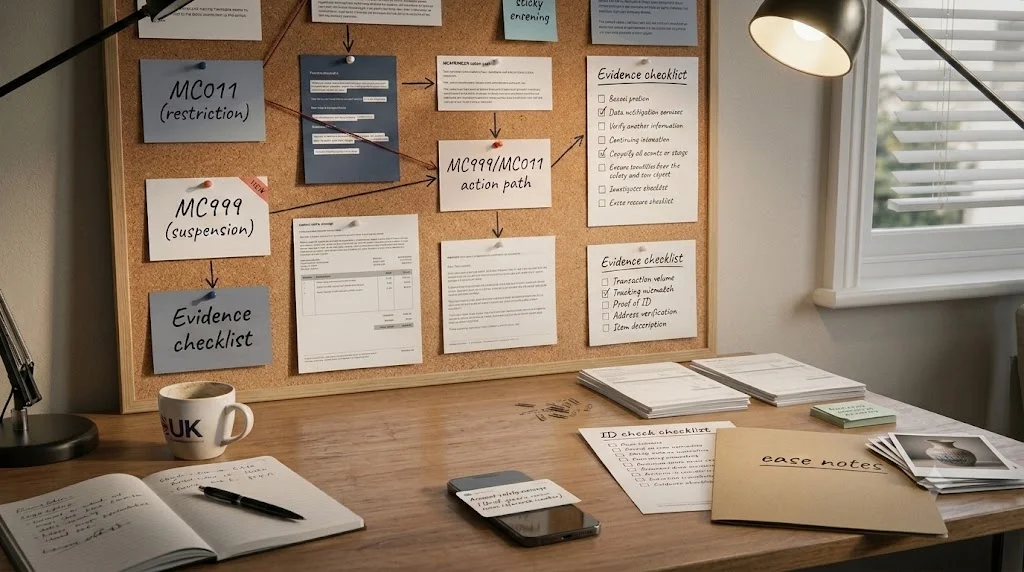
Read this first
If you are searching "what does MC099 mean->", you are not stupid -- you are likely trying to stop money loss quickly. Great. Most people do not know that MC codes are not one standardized public catalog. Sellers get better outcomes when they map the code to actions, not panic.
How to read an MC notice correctly
Start with the subject line. In many cases, the code is only one part of the warning. The subject, the line that says "restriction" vs "suspension", and what the email asks you to send are more important than internet rumors.
Fast split: Listing code means only specific listings are removed first; Account code means sell/create actions are blocked and you need a full reinstatement path.
Common MC codes (practical mapping, not a promise of completeness)
This is the list we can verify from public references and direct warning patterns. If your code is not in this list, treat it as a variant and use the same evidence-first escalation flow.
| Code | What it means | What to do | Likely next outcome |
|---|---|---|---|
| MC999 | Account suspension. eBay is reviewing your account because it has flagged a serious issue. | Submit a complete evidence pack: ID, address proof, and supplier/inventory records for recent stock. | If evidence is accepted, account review can move to reinstatement. |
| MC011 | Account restricted while eBay checks documents and compliance. | Reply to the notice and upload clear, requested documents in one go. | Usually temporary restriction first; it can be lifted if the review is satisfied. |
| MC067 | Listing removed, often linked to counterfeit, quality, or policy concerns. | Pause the affected SKUs and relist only after fixing category, title, and evidence. | Review stays listing-level until repeated breaches raise account risk. |
| MC019 | Listing-level policy violation (for example brand or listing compliance concerns). | Remove flagged listings, then relist with corrected details and supplier evidence. | Usually listing removal first, with escalation only if repeated. |
| MC018 | Listing blocked for listing-content policy mismatch. | Fix the policy issue named in the notice and relist from clean details only. | Usually fixed at listing level first. |
| MC010 | Security warning for account access or suspicious activity. | Treat as urgent, confirm account activity, and secure login/device history. | Can stay at warning level or escalate if suspicious access is confirmed. |
| MC124 | Account is limited and needs identity or address verification. | Submit requested identity and address documents as requested. | Usually a temporary hold until verification is approved. |
| MC115 | Registration or policy suspension, usually blocking account action. | Do not create new accounts; follow the official appeal path and submit requested proof. | Can be lifted if policy/verification checks are passed. |
| MC021 | Compliance and verification risk notice tied to account integrity checks. | Treat as a review notice: submit identity/ownership evidence and avoid opening alternate accounts. | Often stays restricted, and can become suspension if unaddressed. |
| MC113 | Account suspension in older community reports. | Pause listed inventory, gather ownership/supplier evidence, and submit direct appeal through the provided suspended-account channel. | Usually account-level restriction; reinstatement depends on review. |
| MC013 | Hard account hold or suspension reported in seller forums. | Follow the same flow as MC115: appeal through official channels with full evidence. | Higher risk of prolonged hold; requires full review. |
| MC999L | Location-based suspension variant. | Use the same MC999 evidence pack approach in the exact channel listed. | Usually follows suspension review logic. |
The action logic that actually works
- 1
Capture the exact message text
Copy the full subject line, date/time, and any listed action requests. If the sender is in doubt, treat it as real and verify via eBay Messages first.
- 2
Classify: listing issue vs restriction vs suspension
If buyers are being sent to cancel, and only certain listings are removed, you're often in listing-action territory. If all selling is disabled, that is account restriction/suspension territory.
- 3
Build one evidence pack
Upload once, complete once: ID, address proof, supplier invoice, and the affected listing links with exact IDs. Keep a screenshot trail.
- 4
Pause risky actions
Do not open new accounts, do not relist removed inventory under a different structure, and do not continue disputed transactions from suspicious buyers without checking messages.
- 5
Use one escalation path only
Use the appeal/call-to-action link in the message and update it with your same proof bundle. Cross-posting multiple channels usually slows resolution.
The most important UK/US practical difference
In practice, the wording can differ between regions (for example, some support texts and templates differ in whether an account block says "restriction" or "suspension"). So your first move should always be:
- Check the eBay message in account center (not only email client).
- Match the code in this table if possible.
- Open the matching support route from the message and send one complete evidence response.
What usually saves you here
Use-case examples to cut through confusion fast
Example 1: You got MC067 and every listing below a small SKU group has vanished while account sell button still works for other categories.
Likely path: listing policy cleanup first. Remove/rebuild only that SKU group, leave account actions untouched.
Example 2: You received MC011 with no single listing list, and new listings are blocked.
Likely path: account restriction workflow. Focus on ID/address + stock proof + transaction list before any relisting.
Example 3: Buyer appears, then goes "no longer registered user" with MC010.
Likely path: treat as security risk check, inspect buyer path and tracking, protect yourself before dispatch.
What not to do
- Don't open or transfer activity to a new account while any code is unresolved.
- Don't relist removed listings under different wording as a test. That usually creates additional strike signals.
- Don't send incomplete documents from old uploads; blurred scans and partial utility bills delay review.
- Don't ignore "suspension" wording because "it might be temporary." It often is temporary, but only after the correct response.
Bottom line
The real win is not memorizing codes. The win is building a faster escalation flow: capture -> classify -> evidence -> single-channel appeal. If you do that, you reduce the worst-case damage from a code spike.
If you need a cleaner operational playbook for recovery and day-to-day selling, compare this article with how to handle an eBay account restriction step by step.