eBay Global Shipping Programme UK: How GSP Works, Fees & Protections (2026)
eBay's Global Shipping Programme explained for UK sellers: how the UK Shipping Centre works, what a GSP sale actually costs, the loss, damage and feedback protections you get, the price caps and prohibited items, how it compares with posting abroad yourself, and how to opt in or out.
Quick answer
The eBay Global Shipping Programme (GSP) is eBay UK’s managed international postage scheme: you post your sold item to eBay’s UK Shipping Centre like a normal domestic parcel, and eBay handles the international leg, customs paperwork and tracking to buyers in over 100 markets. It’s free to join, buyers pay the international postage and import charges upfront at checkout, and once the hub safely accepts your parcel you’re no longer responsible for loss, damage or delivery claims.
International buyers are some of the best customers on eBay: they pay more for the things UK sellers take for granted, from out-of-print books to discontinued car parts. But posting abroad yourself means customs declarations, uninsured tracking gaps, and eBay Money Back Guarantee cases you can lose through no fault of your own.
The Global Shipping Programme exists to remove that risk. This guide covers exactly how it works for UK sellers in 2026: the step-by-step process, the price caps and prohibited items, what a GSP sale actually costs after fees, the protections you get, and when posting directly yourself is still the better call. Everything here is grounded in eBay’s official Global Shipping Programme help page and its UK fee pages.
GSP at a glance
- You post one UK parcel. Sold items go to eBay’s UK Shipping Centre with a unique reference code. eBay and its postage partner handle everything after that.
- Buyers pay the international costs. International postage and import charges are calculated by eBay and paid by the buyer at checkout, not by you.
- No fee to join. Standard eBay fees still apply, including the international fee (3% for private sellers; 1.05% to 2% for business sellers depending on destination).
- Strong protections. After the hub safely accepts your parcel, you aren’t responsible for loss or damage, eBay refunds the buyer on qualifying claims, and qualifying neutral or negative feedback can be removed.
- Limits apply. Items must be 30kg or under, no more than 120cm on the longest side, and priced £2,000 or less for most destinations (higher caps apply to some countries).
- You stay in control. You can apply GSP per listing, exclude countries, or opt your whole account out and set your own international postage instead.
What is the eBay Global Shipping Programme?
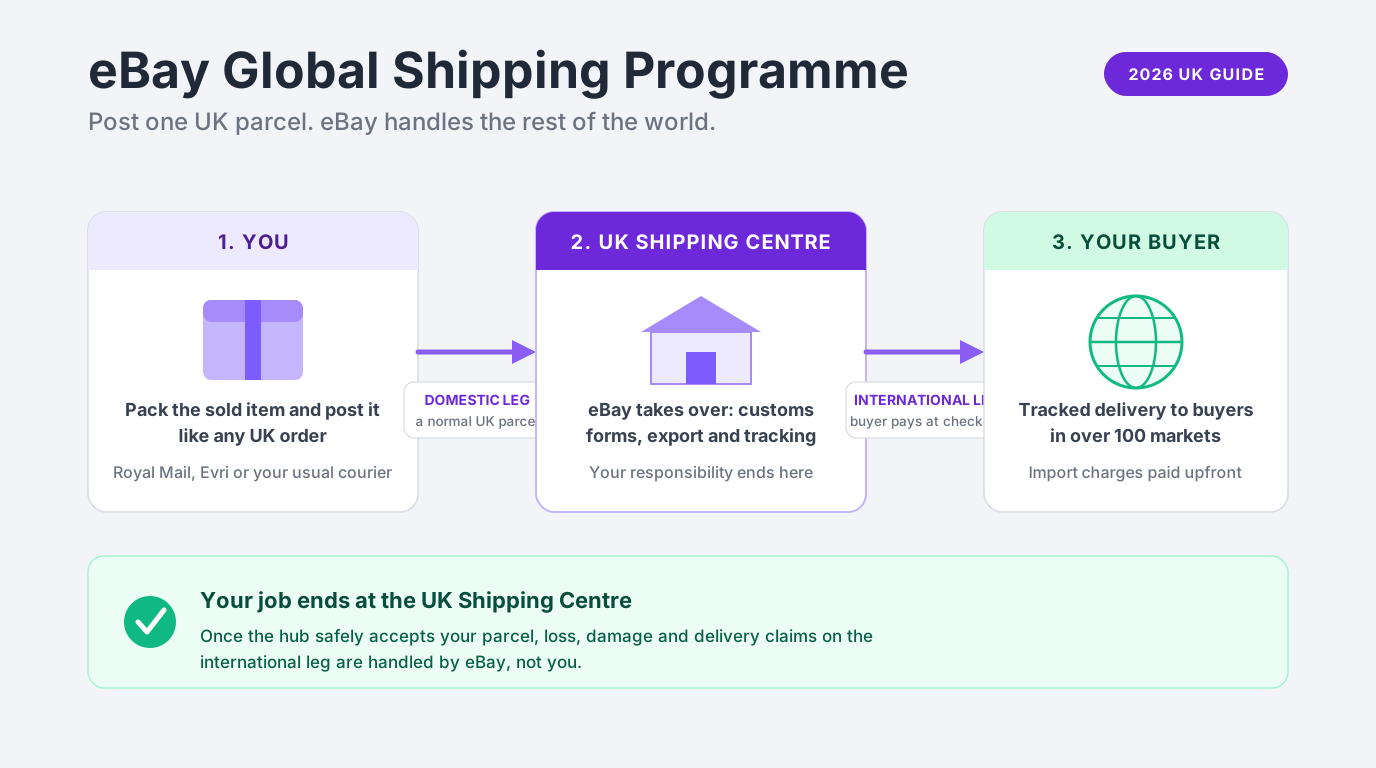
The Global Shipping Programme is eBay’s forwarding service for UK sellers. Instead of you booking an international courier, completing customs forms and hoping the parcel survives a 5,000-mile journey, you send the item to eBay’s UK Shipping Centre. From there, eBay manages the international postage and customs process for every eligible item, adds international tracking, and gets the parcel to buyers in over 100 markets.
Behind the scenes the international leg is run with Pitney Bowes, eBay’s global technology and international postage partner: at checkout your buyer’s payment is split between you, eBay and Pitney Bowes, so you never handle the international postage money at all. To use the programme you need to be located in the UK and listing on ebay.co.uk.
For buyers, GSP listings look slightly different. In search results they see the message “Customs services and international tracking provided”, and on the listing and at checkout they see the full price including international postage and any import charges. That upfront transparency is a feature: nobody gets a surprise customs bill at the door, which is one of the biggest causes of refused parcels and disputes when you post abroad yourself.
GSP vs eBay International Shipping: which applies to UK sellers?
If you’ve researched this topic you’ll have seen two names: Global Shipping Programme (also written the American way, Global Shipping Program) and eBay International Shipping. They’re easy to confuse, so here’s the position:
- For UK sellers on ebay.co.uk, the Global Shipping Programme is the current scheme. eBay UK’s own help pages still document GSP as the managed international option for UK sellers, and it’s what you’ll see in the listing form and your postage preferences.
- eBay International Shipping is the equivalent programme for US sellers. It replaced the US version of the Global Shipping Program. The mechanics are similar (send to a domestic hub, eBay handles the rest), but it’s a different programme with its own terms, and it isn’t what UK sellers opt into.
- You may see both names side by side in eBay policy documents (eBay’s feedback policy, for example, references both programmes), which is exactly why the confusion exists.
Programme names and terms do change, so if you’re reading this some time after publication, the authoritative check is always eBay’s Global Shipping Programme help page and your own postage preferences in Seller Hub.
How the Global Shipping Programme works, step by step
From listing to delivery, a GSP sale runs like this:
- Opt in. Make sure your account is opted in on eBay’s Global Shipping Programme preferences page (see the opt in or out section below).
- Select it when listing. In the International postage section of the listing form, choose Send it to the UK Shipping Centre. Your listing then becomes visible to buyers in eligible countries, with eBay calculating the international postage they see.
- The item sells. eBay sends you the address of the UK Shipping Centre along with a unique reference code for the order.
- Label it correctly. Either print the label eBay provides, or, if you’re using your own label, make sure the unique reference code is included. A parcel that arrives at the hub without its code can be classed as undeliverable, so this step matters.
- Post it domestically. Send the parcel to the UK Shipping Centre exactly as you’d post to a UK buyer: Royal Mail, Evri, or whichever service you normally use. If the item is eligible for Simple Delivery, eBay provides a prepaid label for this leg.
- eBay takes over. Once the hub receives your parcel, eBay manages customs, the international tracked postage and delivery. Tracking updates flow through to you and your buyer automatically, and the estimated delivery date the buyer saw already included the time for your domestic leg.
Multiple orders from the same buyer
If a buyer purchases several items in one transaction, you can pack them in the same box. If the same buyer makes several separate purchases, post each one separately with its own reference code. Combining separate transactions into one box causes customs complications at the hub.
Price caps, size limits and what you can’t send
Size and weight limits
Every GSP item must weigh no more than 30kg, be no larger than 125,000 cm³ in volume, and measure no longer than 120cm on the longest side. That comfortably covers most retail-sized parcels; it rules out furniture and anything pallet-shaped.
Price caps by destination
The default rule: the item price can’t exceed £2,000 (excluding postage). Higher and lower caps apply for specific destinations:
- Up to £10,000: Australia, Canada, France, Germany, Ireland, Italy, Japan, Netherlands and Norway.
- Up to £5,000: a long list including the US, Spain, Belgium, Poland, Sweden, Switzerland, Hong Kong, Singapore, New Zealand, South Korea, the UAE and Saudi Arabia.
- Up to £3,000: Chile. Up to £2,500: Mexico.
- Up to £1,000: several Caribbean and Central American destinations, including the Dominican Republic, Saint Lucia and Belize.
Note the oddity worth remembering: the US cap is £5,000, while nine countries including Australia, Canada and Germany go up to £10,000. If you sell high-value items, that shapes which markets GSP can serve for you.
Restricted categories and prohibited items
Export rules keep some things out of the programme entirely. Listings in these categories can’t travel through GSP: Cars, Motorcycles & Vehicles; Events Tickets; Fragrances (within Health & Beauty); Gaming & Time Cards; Virtual Currency; Websites & Businesses for Sale; Property; and Holidays & Travel.
On top of that sits a long prohibited items list. The entries that catch real UK sellers most often:
- Liquids, powders and aerosols, including perfume and cosmetics, plus nutritional supplements.
- Standalone batteries. Batteries that come included with consumer electronics (AA, C, Li-ion in the device) are the exception.
- Jewellery, gold and precious metals where carrier or customs restrictions apply, and fine art.
- Perishables, plants, seeds, tobacco, alcohol (including samples), weapons and knives, furs, printer toners, and anything on eBay’s general prohibited items list.
Helpfully, you don’t have to police this yourself at listing time: if your category isn’t supported, eBay simply won’t offer GSP to the buyer, and if you’ve set up any additional international postage services it shows those instead.
Selling to Germany?
If you send items to German end users through the Global Shipping Programme, you also need to register with the German packaging authorities (the LUCID register). See eBay’s help page on the German Packaging Act for business sellers.
What a GSP sale costs you (with a worked example)
There’s no fee to join the Global Shipping Programme, and the buyer funds the international leg. What you pay are eBay’s normal selling fees, applied in a specific way:
- Final value fee (business sellers): charged exactly like a domestic sale, at the UK rate, on the item price plus the domestic portion of postage (your leg to the UK Shipping Centre). You are not charged a final value fee on the international postage or the buyer’s import charges. For items eligible for Simple Delivery, no final value fee is charged on the domestic postage either.
- Final value fee (private sellers): UK-based private sellers don’t pay final value fees or regulatory operating fees at all (excluding vehicles), on GSP sales or any others.
- International fee: charged whenever the buyer’s delivery address is outside the UK, GSP or not. Private sellers pay 3%. Business sellers pay 1.05% (Eurozone and Northern Europe), 1.8% (US and Canada) or 2.0% (all other countries). eBay calculates it on the total amount of the sale.
- Regulatory operating fee: business sellers pay 0.35% on the total amount of the sale.
- Your domestic postage cost: the price of posting to the hub, unless the item qualifies for a prepaid Simple Delivery label.
On payment, the split is handled for you: the buyer checks out once, you receive the item price plus domestic postage (where the item isn’t Simple Delivery eligible), and the international portion goes to eBay and Pitney Bowes. You can see every deduction in the Payments tab of Seller Hub, and our free eBay fee calculator will model the fee side for you before you list.
Worked example: a £60 sale to a US buyer
Say you’re a business seller and a US buyer pays £60.00 for a boxed toy (Toys & Games, 10.9% final value fee), plus £3.35 for the domestic leg to the UK Shipping Centre. The buyer also pays the international postage and US import charges on top, but those never touch your payout. Your fee base is £63.35:
- Final value fee: 10.9% of £63.35 = £6.91, plus the £0.40 per-order fee = £7.31
- Regulatory operating fee: 0.35% of £63.35 = £0.22
- International fee (US, business rate): 1.8% of £63.35 = £1.14
- Total eBay fees: £8.67
- You receive £63.35 minus £8.67 = £54.68, and you spend roughly £3.35 on the Royal Mail Tracked 48 label to the hub, leaving about £51.33 before the cost of the item itself.
Two caveats. Business seller fees are shown exclusive of VAT, so add 20% to the fee figures if you can’t reclaim it. And eBay defines each fee’s base as “the total amount of the sale”, so always reconcile against the actual deductions shown in your Payments tab rather than assuming.
The same sale as a private seller looks friendlier: no final value fee, no regulatory operating fee, just the 3% international fee (£1.90 on £63.35). This is where per-order maths gets fiddly across a month of mixed domestic and international sales, and it’s exactly the job DashVue’s profit reports were built for: every payout split into item price, final value fee, international fee and postage, per order.
Seller protections: feedback, loss and damage
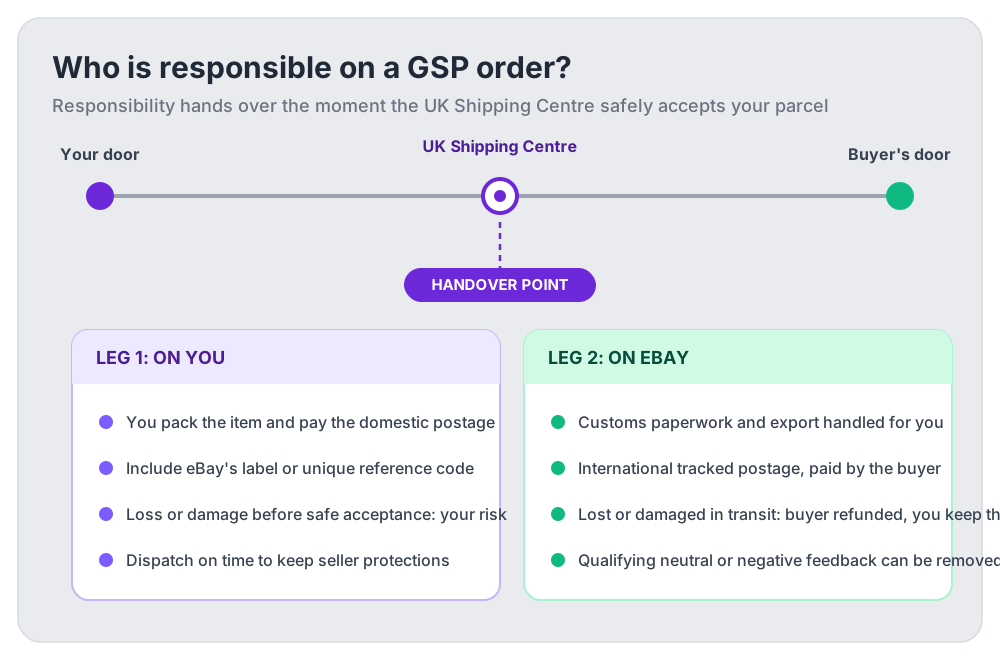
The protections are the strongest argument for GSP, and they all hinge on one moment: safe acceptance at the UK Shipping Centre.
- Loss and damage after the hub: you aren’t responsible for item loss or damage that happens after the hub safely accepts your parcel. If a buyer files an eBay Money Back Guarantee case because the item didn’t arrive or was damaged in transit after that point, you won’t be the one refunding: eBay refunds the buyer and you keep the money from the sale. Don’t refund proactively; let the buyer open the case and let eBay handle it. Any defect from such a claim is removed from your record.
- Feedback protection: buyers can still leave feedback on GSP transactions, but eBay will remove neutral or negative feedback associated with GSP orders in qualifying circumstances, such as delivery-related issues on the international leg.
- Automatic 5-star DSRs: offer free domestic postage to the UK Shipping Centre and you get automatic 5-star protection on your postage cost detailed seller rating. Dispatch same day or in 1 day, upload tracking within 1 working day of cleared payment (or mark as dispatched for untracked services), and get the item to the hub within 3 working days, and your delivery time DSR is protected too.
- Undeliverable items: if the hub accepts your parcel but the item turns out to be ineligible or can’t be delivered (restricted for export, oversized, invalid address and so on), you may keep the buyer’s payment, eBay refunds the buyer itself, and you don’t reimburse the programme’s fees. eBay emails you if this happens.
The mirror image of all this: anything that goes wrong before safe acceptance, a parcel lost between your house and the hub, or one that arrives at the hub damaged because of thin packaging, is still on you. Pack GSP parcels as carefully as any other, and keep your proof of postage.
GSP vs posting internationally yourself
GSP isn’t the only route abroad. eBay UK also lets you set your own international postage per listing (flat rate or calculated, with country exclusions and rate tables), use eBay Delivery powered by Packlink for discounted labels, or list directly on overseas eBay sites. Here’s the honest comparison:
| Aspect | Global Shipping Programme | Posting it yourself |
|---|---|---|
| Where you post | UK Shipping Centre, a domestic parcel | Directly to the buyer's country |
| Customs paperwork | Handled by eBay after the hub | You complete the customs declarations |
| Import charges | Calculated and paid by the buyer at checkout | Depends on the service; the buyer can be hit with charges on arrival |
| Lost or damaged in transit | After safe acceptance at the hub: eBay refunds the buyer, you keep the sale | You handle the eBay Money Back Guarantee case and any carrier claim |
| Feedback | Qualifying neutral or negative feedback removed | Standard feedback rules apply |
| Tracking | International tracking added automatically | Depends on the service you pay for |
| Limits | 30kg, 120cm longest side, £2,000 default price cap (higher for some countries), restricted categories | Whatever your carrier accepts |
| International fee | Applies (delivery address is overseas) | Applies (delivery address is overseas) |
| Cost shown to the buyer | eBay's calculated postage plus import charges upfront, which can look expensive | You set it, so you can undercut GSP and win more international sales |
The pattern that falls out of that table: GSP trades a little buyer-side price competitiveness for a lot of seller-side safety. The total a GSP buyer sees, postage plus import charges upfront, is often higher than a lean Royal Mail International Tracked price, and some buyers browse away when they see it. Posting yourself can win you more conversions on low-value, low-risk items.
Where GSP clearly wins is anything where a lost parcel hurts: higher-value items, slow or unreliable destination postal networks, and any seller whose feedback score can’t afford an unlucky run of “item not received” cases. It also wins on time. No customs forms, no carrier comparisons, no chasing tracking across three postal systems: you post to one UK address and move on. Note that exchanges aren’t supported through GSP, so if you sell items that often get exchanged (clothing sizes, for instance), factor that in.
Plenty of sellers run both: GSP as the default, plus their own postage options on listings where they can beat eBay’s price. If the category isn’t GSP-supported, eBay automatically shows your own international services instead, so the two coexist happily on one account.
Returns, refunds and undeliverable items
Returns follow your normal returns policy, with eBay picking up the international pieces:
- Your UK returns policy extends to EU buyers. If you offer free returns to UK buyers, EU buyers get it too. Under the EU Consumer Rights Directive, EU consumers have 14 calendar days to tell you they want to return an item bought from a business seller. For non-EU buyers, eBay may not display your returns policy, and encourages you to agree arrangements directly.
- Change of mind: the buyer sends the item back to you and you refund the item price plus the domestic postage only. The buyer asks eBay customer support for the international postage refund; that part is eBay’s responsibility, not yours.
- Item not as described: you refund or replace the item and refund the domestic postage; eBay refunds the buyer’s international postage.
- Exchanges: not supported through the programme. If you agree an exchange, you send the replacement via your own international postage provider.
- Undeliverable after acceptance: as covered under protections, eBay refunds the buyer, you may keep the payment, and the item is disposed of as undeliverable. Reasons include export restrictions, oversize parcels, invalid addresses, cancelled orders, damage at the hub, or a missing reference code.
VAT, customs and the paperwork GSP handles
Since Brexit, every parcel to the EU is an export with real paperwork attached. This is the part of international selling GSP quietly removes:
- GSP shipments always leave the UK and count as exports for VAT. Buyers pay import VAT and duties on their order at the rate that applies in the delivery country, calculated and collected upfront at checkout. You can request export details from eBay customer service if your accountant needs them.
- UK to EU price adjustment: for shipments between the UK and the EU, eBay adjusts the item price to remove UK VAT where it’s included, and the buyer pays their local import charges on the adjusted price. No double taxation, no manual invoicing gymnastics from you.
- EORI numbers: business sellers moving goods from Great Britain into the EU need an EORI (Economic Operator Registration and Identification) number, and you may be asked to provide it to facilitate EU shipments.
One thing GSP does not change: those export sales still count towards your turnover. If your international sales are growing, keep an eye on the £90k VAT registration threshold the same as you would for domestic revenue.
How to opt in or out of the Global Shipping Programme
Opting in
- Opt your account in at eBay’s Global Shipping Programme preferences page (linked from the official GSP help page).
- On each listing, in the International postage section, select Send it to the UK Shipping Centre.
- To apply it in bulk, use eBay’s bulk editing tools, or, if you’re enrolled in business policies, include the Global Shipping Programme in your postage policies and apply those to eligible listings. Third-party listing tools handle it through their own settings.
- You’ll find your GSP-eligible listings in My eBay, or under the Active listings view in Seller Hub.
Opting out, or customising
- Handle international postage yourself: select Create your own international postage option in the listing form and set your services, costs and destinations.
- No international sales at all: select No international postage in the How you’ll post it section.
- Fine-grained control: you can exclude individual listings or specific countries from the programme, or exclude your whole account, from your GSP settings.
Opting out isn’t all-or-nothing, and it isn’t permanent. Many sellers exclude a handful of destinations with painful customs regimes and leave the rest of the world on.
FAQ: eBay Global Shipping Programme
Is the Global Shipping Programme free for sellers?
There’s no fee to join, and the buyer pays the international postage and import charges. You still pay eBay’s standard selling fees: final value fees for business sellers (on the item price plus the domestic postage portion only), the international fee for both private (3%) and business sellers (1.05% to 2% by destination), and the 0.35% regulatory operating fee for business sellers.
Has eBay International Shipping replaced GSP in the UK?
No. eBay International Shipping is the programme that replaced the Global Shipping Program for US sellers. For UK sellers listing on ebay.co.uk, the Global Shipping Programme remains the current managed international postage scheme, documented on eBay UK’s own help pages. If that changes, eBay’s GSP help page and your postage preferences are the places it will show first.
What happens if my item is lost or damaged after it reaches the hub?
You keep the money from the sale. The buyer opens a case on eBay and receives their refund from eBay, not from you, and any defect from the claim is removed from your seller record. Don’t refund proactively: once the claim is filed, it should be escalated to eBay customer support to action. Before the hub safely accepts the parcel, though, the risk is yours, so keep proof of postage for the domestic leg.
Can I use Simple Delivery with the Global Shipping Programme?
Yes. Simple Delivery covers domestic UK deliveries, and if your item sells to an overseas buyer through GSP, you can use your Simple Delivery prepaid label to send the parcel to the UK Shipping Centre. The buyer is charged for that label unless you offered free postage. For eligible items there’s also no final value fee on the domestic postage. See our full Simple Delivery guide for how the labels work.
Why does my item show as unavailable to some countries?
Usually one of three reasons: the item price exceeds that destination’s cap (£2,000 by default, with higher caps like £10,000 for Australia, Canada, France, Germany, Ireland, Italy, Japan, the Netherlands and Norway, and £5,000 for the US), the destination isn’t on the GSP eligible country list, or the category is restricted for export. eBay suppresses the GSP offer automatically in those cases and shows any of your own international services instead.
Do I pay final value fees on the international postage?
No. For business sellers, the final value fee is charged at the UK rate on the item price plus the domestic portion of postage (your leg to the hub). There’s no final value fee on the international postage or on the buyer’s import charges, and no final value fee on domestic postage for Simple Delivery eligible items. See our complete eBay fees guide for how the rest of the fee stack works.
Sources
- eBay UK Help: Global Shipping Programme : how it works, price limits, eligible countries, protections, restricted items, fees and the returns FAQ.
- eBay UK Help: International postage for sellers : GSP benefits and the direct posting alternatives, including Packlink and rate tables.
- eBay UK Help: Fees for business sellers : final value fees by category, the 0.35% regulatory operating fee and the business international fee table.
- eBay UK Help: Fees for private sellers : free private selling and the 3% private international fee.
- eBay UK Help: Simple Delivery : using Simple Delivery prepaid labels for the domestic leg of a GSP order.
eBay’s programme terms, price caps, fee rates and country lists change over time. Figures above reflect eBay UK’s published help pages at the time of writing; always confirm against the live pages and your own Payments tab before relying on them.